

Finding the Middle Path: The Spirit-Science Synergy of Teilhard de Chardin and Thomas Berry
Click for this Resource!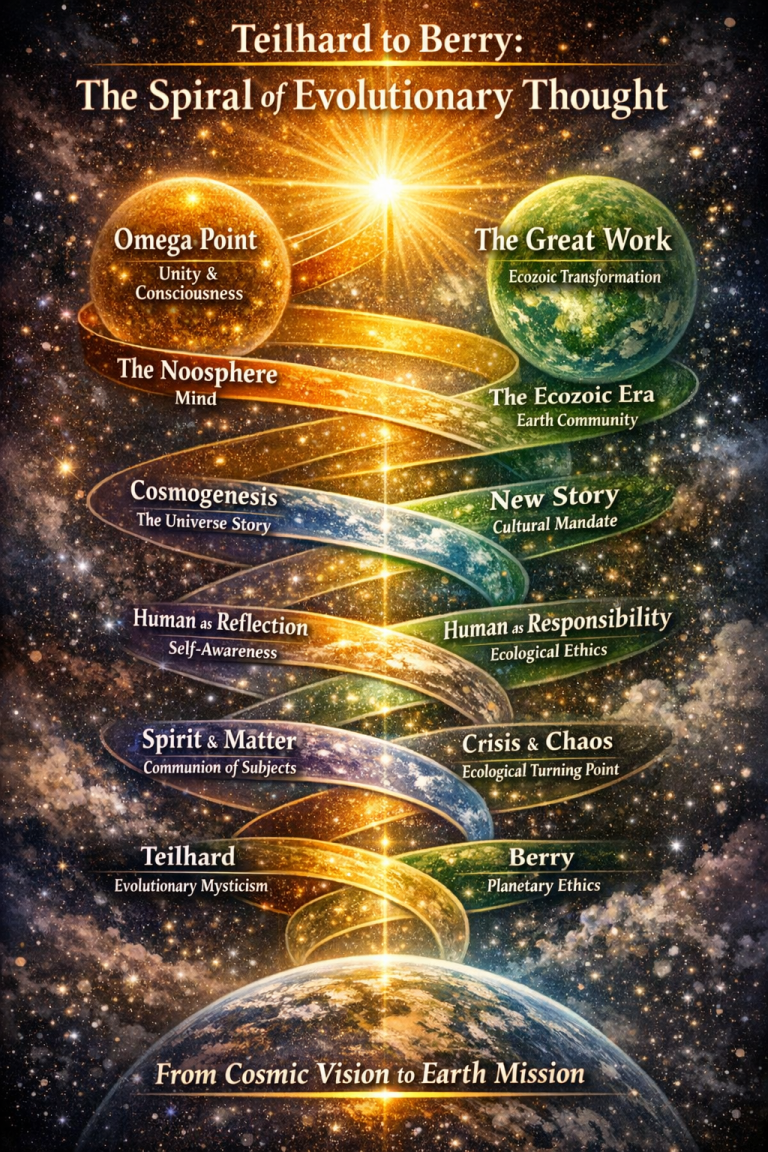
Our challenge is to create a new language, even a new sense of what it is to be human — Thomas Berry
Introduction
Thomas Berry believed that ethical behavior emerges when humans align with the universe’s actual dynamics — a triad of differentiation, interiorization, and communion — whose ethics are grounded in cosmology. He developed this perspective having gleaned from Teilhard’s cosmogenic model detailed in the author’s previous 10-Part DTN blog series. However, Berry’s cosmology did so deliberately eschewing Teilhard’s references to God, Spirit, or theology, the heart of Teilhard’s model. This blog entry will explore why Berry did so, and why the distinctive cosmogenic notions of each theologian varied. On closer examination, their perspectives seem to reflect differences less in kind or substance, than in divergent language calling for clarification. The challenge for those who follow is to take their wisdom to a higher octave, discovering that transcending differences is better than debating them, compromise, retreating into silos and corners, or agreeing to disagree.
Surviving as a species requires those in the Quantum Age to develop a broader bandwidth of consciousness leading to a higher level of awareness in order to see and think in wholes, guiding others to do the same. The new sciences and traditional religions both describe the same Source of wisdom and require those who adapt and become evolutionary leaders to bring those siloed disciplines, and us, closer together in unitive consciousness, becoming clearer about what that means, and articulating it to others in creative and novel ways. This can only be accomplished by liminality and liminal consciousness, those fluid mental states between space and time, the middle path between creative energy and ordinary thought. Liminal consciousness integrates our everyday sense of the world (rational-empirical) and the experiences that flood into our awareness during contemplative states (subjective-intuitive) like dreaming, mindfulness, or other portals such as art, music, dance, and nature, aveneus that calm the brain. Such liminal space is the in-between common ground of spirituality and science. These liminal, or common ground experiences allow for a deeper wisdom that do not originate in the neurons of our brain and body. The next generation of thinkers and teachers must be the “better than” generation of wisdom teachers, those who have learned to see, think, and organize a step or two beyond those who have gone before them.
Parting creatively from the timeworn trail of convention and tradition via liminal consciousness, the previous 10-Part blog series lays the groundwork to reconcile siloed differences and satisfy the future challenges of Teilhard de Chardin and Thomas Berry. Teilhard’s ultra science vision had the evolution of mankind (noosphere) pointing toward the development of an ultrahuman species in Omega. Berry’s vision challenged those who followed his eco-theological model to “create a new language” in a “functional cosmology” that tells a New Story in what he termed the future Ecozoic era. This era calls for a new cosmological orientation grounded in the Universe Story as our sacred narrative; to include transforming governance, economics, education, religion, and technology to serve the flourishing of the entire Earth community. Such was to be a more complete story of the unfolding universe, a geological-scale transition that transform ways of seeing and preserving the environment while leaving a fresh new trail.
Each man found the beginnings of that convergent trail in a different way. Teilhard posited that a sacred narrative was to identify a sacred element that lay hidden at the “heart of matter” fueling evolution from the “within of things,” one whose esssence would one day be identified by a more advanced, interior-discerning science of physics. Whereas Berry framed his ecological perspectives more exclusively along earth science, human responsibility, and ethical lines, calling for new religious sensitivities that re-sacralize the Earth.
Both men were priests. Teilhard immersed in field work as a scientist-theologian (paleontologist). Berry was not a scientist in the traditional academic sense, but a cultural historian, philosopher, and scholar of world religions who referred to himself as an ecologian (or geologian). Had they lived in the same era, each man might have borrowed the other’s “eye” to see the trail more clearly as an integrated whole, reconciling their divergent worldviews. Following on the heels of the 10-Part series on Homo spiralis evolution and convergence, this blog entry is an effort to provide an “excluded middle” (middle path) perspective, combining their individual models into a spirit-science friendly picture of the whole (see graphic at top).
Teilhard believed that spirituality is primarily about seeing and reconciling paradoxes (contaries and opposites) that ordinary human perception and thought were given to divide and fragment via separation consciousness (binary thinking) — like religion and science, spirit and matter, spirit and soul, soul and body, etc. However, Teilhard argued, when consciousness transcends the psychogenic stage of being, it becomes spiritualized, the beginning of what he termed the “christified” stage of evolution (or Christogenesis) which consummates in the Omega Point and Pleroma. Beginning in this spiritualization of consciousness stage, cosmogenesis organizes around a new center and self. The chief perceptual property in this stage results in unitive consciousness, enabling one to see and experience all things as organized around a deeper center, or unified field that is one and undivided as Source. Attaining this milestone in personal development and/or collective evolution results in a higher order of perception and thought, and the ability to see and define the seamless unity of all things with greater clarity.
Once envisioned, the discovery of this mythic inroad would lead to an upgraded synthesis model like the one proposed by Teilhard and Berry, similar in design to that framed in the author’s book, and recent 10-Part blog series. The Source and substance of that model are rooted in geometry and spiral dynamics. This novel synthesis trail is found by navigating the tricky path between the established forces of scientific materialism, religious orthodoxy, and academic psychology, all of which claim pieces of the mystery but miss the whole of it.
The phi-spiral (double-spiral) paradigm of the author’s Homo spiralis framework reconciles religion and science by naming their common element in a generative energy, architecture, and information field in which all things consist, cohere, and ground universally. Religions traditionally refer to this ground of being as “God.” This synthesis model also pivots on the contributions of physicist Albert Einstein, electrical genius Nikola Tesla, architect Buckminster Fuller, and current studies on the nature of consciousness, which collectively reveal that everything that appears solid in the world is a Jacob’s Ladder (spectrum) of vibrating electromagnetic frequencies — the common denominator of astronomy, mathematics, and music. Recall, electromagnetism is another name for light energy, and the electromagnetic spectrum is that which measures and marks the broad bandwidth of frequency vibrations within it, both visible and invisible.
The Cosmic Octave Hierarchy, a symphony of light and sound
The existence of this Cosmic Field provides a plausible explanation for many unexplained phenomena once considered pseudo-science, such as life after death, near death experiences, extrasensory phenomena, extraterrestrial intelligences, the Shroud of Turin, crop circle formation, anti-gravity propulsion systems, and the mystery of consciousness, the latter now increasingly understood as having qualities that operate more like an antenna receiving inputs from the global energy and information field at large, independent of brain function that never die.
Architect Buckminster Fuller called the structure of the unified field a Cosmic Octave Hierarchy, and understood that everything is energy and consciousness, with zero pulsation (the ZPF) being the nearest scientific approach to the eternal that empirical science will ever know. Like Einstein, Teilhard also considered matter as frozen energy, “spirit, moving slow enough to be seen.” The Homo spiralis model checks all these spirit-science boxes in an integral way, including Berry’s call for creating an new language that tells a New Universe Story.
Whether in ancient mystical systems, Platonic philosophy, Abrahamic faiths, or modern physics, light energy repeatedly emerges as the primal principle in the universe, both literal and metaphoric, causal and revelatory implications of light as being the Source, center, circumference, and bridge (web) connecting all things.
Spiral alignment, cosmic energy fields, architecture, and Zero-point axis (detailed sequentially in a previous 10-Part blog series )
Integrating the notions of Einstein, Tesla, Teilhard, and Berry, including perennial wisdom traditions, and neuroscience studies, the author’s Homo spiralis model identifies the cosmic generative energy and information field(s) originating from what science terms the Zero-Point Field (ZPF), or plenum, intimately associated with CMBR (Cosmic Microwave Background Radiation) whose radiant curtain of cosmic surround-sound spreads across the entire universe. In religious cosmology, the ZPF, or vacuum state is known as the axis mundi, whose vortex is the navel (magnetic still-point) from which all opposites and contraries in nature emerge, revolve, and reconcile — and that only unitive consciousness formed by a spiritual breakthrough can see and experience. The words ‘ZPF,’ ‘universe,’ ‘axis mundi,’ ‘magnetic still-point, and ‘God’ basically reference the same thing. Ironic, in that the word “universe” means to ‘turn around on one thing.’ Light is the leading all-purpose candidate to be that one thing, the common element (and universal solvent) in which all things consist and cohere.
The Field also calls into play Sacred Geometry, identifying the geometric architecture that holds all things together universally, whose ethics are grounded in spiral alignment. Along synthesis lines, that alignment provides inroads into revising notions of divinity as embedded in complex energy and information fields that convert uncreated light (radial energy) into created light (tangential energy), positioning the entire created order on a broad bandwidth (and foundational baseline) of vibrating electromagnetic frequencies at all scales.
This has profound philosophical and religious implications for understanding the God-of-the-Whole as a pan-psychic generative energy and information field (divine milieu) swaddling the entire created order. In the Homo spiralis paradigm, the vehicle of continuity for this energy is a geometric spiral (with double helices, and dual-aspect monads) by whose operations nature forms energy into matter, and is the only geometric form where all forces are equal and balanced. These energies and its spiraling architecture carry the invisible blueprints (archetypes) upon which the entire created order, including DNA, is structured.
Connecting the visible and invisible world in this way joins the world of material forms and images with their animating cosmic principle and Source. At the same time it reveals the inward pathway (middle-path migration) toward a deeper awareness of a spirit-science synthesis, synergy, and cosmic nexus (sweet-spot) hidden in the human spirit-soul. Discovering this pathway via a spiritual breakthrough liberates the spirit-soul from what the Logos (Cosmic Christ) refers as the ego or body self, nationhood, scientific materialism, institutional religion, and mass culture, along with social, educational, and emotional programming whose transformed energy re-organizes in an advance and transcend choreography of evolution.
Nexus between the visible and invisible world: Consciousness as Source = Spirit
Like the electromagnetic energy (light) that fuels it, the Zero-Point vortex (ZPF) and its overlapping energy fields, sometimes called the Vector Equilibrium (VE), is the nexus between the visible and invisible worlds. The VE energy lines (called vectors) are of equal strength, representing the energy of attraction and repulsion, force fields one can feel with a magnet. Like electromagnetism (light energy), the ZPF cannot be imaged, only inferred by its effects. That is, by the very act of giving energy, the ZPF (or VE) actually makes itself invisible by establishing and restoring balance to all things via its invisible wheel-works, a trait likewise descriptive of divinity taught by traditional religions. Though unknown and unnamed scientifically by both Teilhard and Berry, this mystery energy (Light = Spirit = pure consciousness) was hypothesized by Teilhard in his time as having a yet unnamed scientific base in physics, and whose Source infuses life from the heart of matter. (Click onto video short in Resource box on the “Second Zero,” and X-out of the Facebook box to view)
The spiral, universal signature of an Archetypal Artist (See Part 3: The Spiral Dynamic)
The spiral is the ZPF’s cosmic geometric conduit that spin-spirals energy from its vortex, the magnetic still-point located in the center of the spiral like the eye of a hurricane. This portal is the Source of Teilhard’s radial and tangential energy, and their space-time infusions, tensions, paradoxes, and energy transformations at all cosmic scales. Such is the subject of quantum and classical physics, psychodynamic psychology, and spiritual transformation respectively. The abundant energy that flows forth from these spiraling ZPF vortices is actually one energy with many apps that vibrates at various frequencies and animate the activity of creation and the substance of all forms. In spiritual consciousness, the mind is an observer that recognizes this as both subject and object that becomes an avenue of awareness for them.
Of note, 99.999% of the space within and between things is not empty, but comprised of countless electromagnetic entities, atomic and subatomic, melding in an invisible web. All spiritual masters have spoken of that still-point, a centering singularity hidden within all things. Along scientific lines, it is now clear the universe exchanges information with each atom via microtubules based at the cellular level, enabling this pan-psychic energy field (God-of-the-Whole) to be present and connected everywhere, rendering all of creation sacred. Hence, God = a pan-psychic (numinous) energy presence, connecting inner and outer worlds, comprising the innermost and swaddling the outermost of all things. This means that the soul and spirit (Teilhard’s spirit-soul) is not in the body as traditionally thought. Rather, the reverse is true, the body is in the generative energy and information field of the spirit-soul and derives its animating life from that cosmic context (energy field).
Spirals are the unnoticed, free-for-the-viewing signatures of the divine hidden in plain sight, indelibly written in the fabric of the universe at all scales. It is a truism in most spiritual traditions that divinity is well disguised in creation, usually found where least expected, hidden in the center of things. As any artist knows, a literally perfect style should conceal itself so completely that it goes unnoticed. All art and creativity mimic the Archetypal Artist who inspires, creates, forms, and out-pictures all things from invisible templates, leaving its spiraling signature in and on them, manifesting itself as them in sounds and images everywhere.
These geometric forms reveal something about the invisible scaffolding on which all things rest, the vital energy that informs their moving parts, and the patterns that connect them. These evolutionary discoveries on the nature of things invites science to re-interpret tribal views of God along more universal lines — according to Teilhard, as embedded in a divine milieu. In pure form, this cosmic energy is free of all names and bare of all forms, exists everywhere, and in all things. Like the sunshine, rain, or air we breathe, this hidden matrix is common property shared by all, owned by none, and that becomes aware of itself in humans.
This is not analogy or metaphor, it is structural identity. Berry’s triad provides the cosmic calibration for Teilhard’s ultra synthesis vision and the spiral’s balance, because:
~ when persons expand without coherence and integral interiority, distortions result
~ when they deepen interiority without communion, narcissism results
~ when they seek communion without differentiation, boundary-less confusion results
Formal (technical) spirit-science definition of the God-of-the-Whole
God is the universal name for the primordial interiority of the cosmos — the self-organizing, consciousness-bearing, overlapping, generative energy and information field that gives rise to matter, life, mind, and the progressive interiorization expressed in cosmogenic evolution. This evolving process is described in this series via the Homo spiralis arc. Of course, the experiences of same are more deeply personal and inexpressibly powerful, just as the sweet aroma of a flower, the rich taste of chocolate, or the ecstasy of love, as subjective experiences, go far beyond a description of the biochemical breakdown and technical (formal) explanations of same. One can measure life by quanta, but its qualia that give it meaning, verve, and make it all worthwhile.
As the universe’s intrinsic depth-dimension, God is the unifying operator through which differentiation, relationality, and coherence emerge and evolve. In this framework, the God-of-the-Whole is not an external agent but the immanent creative intelligibility of cosmogenesis itself: the Source, direction and interior lawfulness by which the cosmos advances toward complexity, objectivity, subjectivity, and integrative unity. As such, the perception of God must be “de-nouned,” understood as a unity field, the relational field that binds all levels of reality —physical, biological, psychological, and noetic (intuitive) into a single cosmogenic process.
How this definition integrates with Teilhard, Berry, and the Homo spiralis framework.
God is the interior axis of the spiral, the vector of interiorization, the tendency of the universe to produce beings like itself capable of self-awareness, empathy, symbolic meaning, and ultimately Omega-level coherence. That interior axis is the silent dimension of depth that drives the transition from:
~ energy —> plasma
~plasma —> matter
~ matter —> life
~ life —> mind
~ mind —> reflective consciousness
~ reflective consciousness to Homo spiralis coherence –> transfigured in Omega –> toward the Pleroma from whence it came.
Reconciling Teilhard and Berry in the Homo spiralis framework
Schooled in science as a paleontologist, Teilhard held fast to his theology throughout, whose ancient manuscripts affirmed that divinity was hidden at the center of things at the “heart of matter.” With an eye toward the future, and at great personal cost, he recognized that developments in science would eventually catch up to affirming what spiritual mystics and masters had intuited and experienced firsthand for centuries.
By contrast, Berry, himself a scientist-priest (eco-theologian), distanced himself from the dogmatic power and control centers of ecclesial authority. Like Teilhard, he was acutely aware that the G-word and inherited theological language carried too much historical distortion. It had become anthropocentric, tribal, moralistic, dualistic, and was disconnected with the biosphere and cosmology with no ecological concern, and no regard for the intertwining of matter and spirit in nature. So as an alternative, embracing the independent spirit of scientific inquiry and investigation, Berry left those centers of ecclesial power and went to scientific cosmology, the Earth sciences, and the spirituality of indigenous cultures to build a cosmology paradigm and alternative community unfettered by the dogmatism of western institutional religion.
Berry argued that ethical life must be grounded in objective reality, understood not as human centered rationality, but as rooted in the empirical structure and developmental dynamics of the universe itself disclosed through cosmogenesis, ecological science, and the living Earth.
He reasoned that the universe is not merely a backdrop for human action but the primary revelation of how life coheres, differentiates, and deepens. Its three fundamental dynamics — differentiation, interiority, and communion — constitute the structural grammar of reality. To live ethically is to align human consciousness with these cosmological patterns: to honor the uniqueness of each being, to recognize the interior spontaneity present throughout the natural world, and to participate in the relational fabric of the Earth’s community of subjects. Although all the above was held in sacred regard by the spirituality of global indigenous cultures and perennial wisdom traditions, it was minimized by western institutional religion.
The Homo spiralis framework builds upon Teilhard’s vision and Berry’s insight by interpreting the human as a cosmogenic phase Berry refers to as the universe’s own unfolding, whose spiral arcs of expansion, subjective depth, and integrative coherence mirror the very tendencies that have guided the cosmos from its inception in a blazing glory of cosmic fire. Before his passing in 2009, Berry intuited that science was entering its wisdom phase, while Teilhard left off in 1955 seeing religion as on the cusp of entering and embracing its scientific stage. Neither man’s divergent view ever fully integrated via an “excluded middle” synthesis, at least not publicly. That’s because the excluded middle (middle path) in every apparent paradox (contrary) always remains hidden until said opposites reconcile, transforming binary perception and thought into unitive consciousness, the hallmark and byproduct of spiritual enlightenment (see Part 5).
Berry’s view implies that this ethical transformation is not merely a cultural invention that happens in a vacuum, but a deepening attunement to the universe’s own creative energies, geometric architecture, and evolutionary trajectory — a re-entry into the larger story that has always held us, revealing itself in greater detail along the evolutionary way. But much like Teilhard, Berry left the challenge of identifying many of these details to those who followed.
While Berry and Teilhard both described that re-entry using their own language, today their followers are challenged do so in more specific spirit-science detail and synergy. Teilhard died (1955) wondering who would give the world the meta-theology (metaphysics) in a unified paradigm that synthesis seekers were looking for. Berry called for a “functional cosmology” that would restore a desacralized and degraded biosphere. As visionaries, both men anticipated the realization of their “cosmovision” in the future, knowing they would not live to see it. The time is at hand for developing a novel synthesis that tells a new story in a single paradigm, built upon the foundation of these cosmogenic trail blazers.
Relationship between inner (transformed) and outer (performed/conformed) change
Thomas Berry knew that “The ethical transformation of society requires a psychic transformation of the individual.” That is, one cannot expand (spiral) outward ethically, unless one spirals inward with greater depth. Of note, there is no greater depth in the human interior than change that sees and thinks in wholes beyond psychogenesis (Teilhard’s Christogenesis). This evolutionary milestone in personal development and cosmogenic evolution exceeds the highest milestone in psychogenic evolution by an order of magnitude. Lest efforts toward ecological/ethical responsibility be performative, breadth without depth, action without substantive interior change usually has a brief shelf life, confirmed by the world’s wisdom traditions. The difference between performative behavior and transformative change fueling behavioral change, is like the difference between creating a new suit for a man, or a new man for a suit. One involves exoteric knowledge (outside-in), the other esoteric knowing (inside-out). Both belong together like the inside and outside of a glove, reconciled as any set of contraries in a paradox.
Again, enlightened consciousness is primarily about seeing and reconciling contraries (opposites in a paradox), learning to hold their tension in ways that transform and develop an “excluded middle” (middle path) perspective, otherwise hidden an inaccessible in the human psyche. This transformation principle is the subject matter of both psychology and spirituality, disciplines that study the developmental processes, assess irregularities of the interior life, and guide others in their interior work, including mastering the spiritual disciplines.
In his time, these transformational processes were referenced in Teilhard’s religious tradition as the “narrow way” or “strait gate,” the point of differentiation, integration, interiorization, and communion that Berry advocated for in a “functional cosmology.” This is the balance point, “sweet spot,” or middle path between contraries that the Logos (Cosmic/Universal Christ) declared “few find” when/if not awakened or initiated into these sacred mysteries by advanced wisdom teachers. Many principles involving the spiritual mechanics of how to attain unitive consciousness were filtered out, censored, and/or banned under penalty of death in the third century A.D. by ecclesial authorities. This institutional hierarchy and its appointed councils were opposed to the ancient manuscripts and holy books that revealed them because they were a threat to the ecclesial authorities, made dispensable owing to their teachings that no priestly mediation was required to directly access their mysteries.
Outlining a complete Teilhard-Berry spirit-science synthesis with breadth and depth
Since Teilhard’s passing in 1955, and that of Berry in 2009, no synthesis model with a viable spirit-science core has been proposed that transcends psychogenesis (the reflective stage of mind and culture). However, several synthesis groups continue to present and refine their own models by sidestepping the lifeblood and structure of same. Any comprehensive updating of either Teilhard or Berry’s work is challenged to find a way to reconcile their differences, preparatory to fulfilling each man’s mandate, by (a) effectively naming the spiritual energy, mechanics, geometric architecture, and stages of cosmogenic evolution beyond psychogenesis, (b) showing the integral relationship between depth and breadth, interior transformation and ethics, in a single framework, (c) being inclusive of Teilhard’s ultra physics, and advancing Berry’s ecological directive for a “functional theology” that tells an updated Universe Story, (d) aligning the new story with perennial wisdom principles, including a process theology that connects inner and outer worlds common to global religious traditions, and (e) connecting same to what is thus far known about advanced off-world civilizations and their technology.
Breadth without depth is performative, mere action without an evolved (transformed) interior center as Source and organizing principle. Depth without breadth is specialization, crossing over into exclusivity, narrow mindedness, and myopia. Berry’s ethics are not performative, they’re ontological. That is, they operate on the invisible fundaments of reality, believing that an objective reality exists beyond our observation and is to be informed by a wise mix of empirical, evolutionary, cosmological, ecological, and scientifically defined spiritual energy and information dynamics that fuels and maintains them. Properly integrated, an updated model’s components (chapters) should tell a more complete New Universe Story and/or introduce a New Science of Humanity. That pioneering science would fully embrace the empirical, intuitive, and trans-rational dimensions of knowing in its broad bandwidth and design.
Teilhard provides the depth, Berry the breadth, holy books the height and spiritual mechanics — and Homo spiralis identifies the evolutionary energy, geometric structure, and nuancing to reconcile these components and viewpoints.
Berry’s view: Ethics at the threshold of a spiritualized universe
Every transformative era begins with a shift in how reality is understood, and of necessity must include a balance of breadth and depth, ethics and responsibility rooted in integral wholeness. Thomas Berry argued that the ethical crisis of our time is at its root a crisis of cosmology — a failure to perceive the universe as it actually is. Very few ever come to see the world as it is, clearly and steadily, without this kind of full-orbed seeing and full access knowing. Each of those ways of knowing contains a partial truth, which when combined allows the whole to be seen as it is, not as we are — less-than-whole investigators. There is more to being whole, and the experience of being alive than being limited to the empirical as a means of knowing. The post-modern world is inclined to overvalue the rational and discursive at the expense of the trans-rational, numinous, and intuitive, the latter of which have much more to do with depth. At the last, both Teilhard and Berry would attest to same.
Dynamic tension: the tensional integrity (tensegrity) between breadth and depth
Today’s world is marked by speed and sound bites, overwhelmed with an incalculable volume and breadth of information. Consequently, the educated person of our time has been programed to absorb around 300 miles worth of informational breadth, and three inches of substantive depth. As a result, post-modern educators tend to focus on diversity and the expense of unity, to say nothing of knowing the process(es) involved in bringing the parts together, or how each differentiated entity orients to a well-defined cosmic center. Hence, the depth areas of cosmogenic evolution (intuitive and trans-rational) that make up the whole person, and with it unitive consciousness, are found wanting. They must be shored up to create the requisite depth-breadth tension that restores balance. Berry’s “communion of subjects” can only be experienced by de-objectifying what only appear as a “collection of objects” to the materialistic inhabitants of a commodified, throw-away world.
Resistance of religious, scientific, and academic orthodoxy
Meanwhile, most of the scientific and academic communities are not ready to include same into their materialistic-empirical designs. Similar to dogmatic religion, those communities have been historically averse to change. At the same time, progressive synthesis thinkers who stand in the gap equipped to reconcile siloed disciplines and opposing views, understand that marrying these siloed entities, like marriage itself, stands to change each partner significantly, and forever. In the process, it will also change themselves as innovators, bringing the noosphere’s remnant along with it. For earnest trail blazers, such is no place for the lukewarm or fainthearted.
Berry & Teilhard agree: The universe is the primary revelation and organizing principle
For Berry, ethical life cannot be grounded in human preference, cultural convention, or abstract moral theory. It must arrive at objective reality, from the deep structure of the universe disclosed through cosmogenesis, ecological science, and the living Earth. Teilhard’s religious tradition referred to that objective foundation as the Word (Logos), the deep, universal organizing principle of reality, the rational energy and structure behind existence that Teilhard called the Cosmic or Universal Christ, the prime mover and first cause of all things. By contrast, modern and postmodern eras have taken humanity away from seeing things as they are in their depth. This occurred in the modern world (late 19th century) by having folk question authority to the point of suspicion, and in the post-modern era (1950s-70’s) by questioning reality itself, declaring that reality doesn’t exist objectively, and that all things are relative. No true synthesis model will hold up to that kind of thinking in its construction.
Rooted vs. eclectic spirituality
At a glance, the viewpoints of Teilhard and Berry can sound “New Age Adjacent” because they talk about consciousness, evolution, and the sacredness of the cosmos, but their frameworks are actually quite different in grounding, method, and aim. Both men work from within a coherent intellectual and spiritual lineage, philosophy, and science. Teilhard integrates evolution with the Cosmic or Universal Christ, and Berry develops a “Universe Story” grounded and framed in cosmology and Earth systems. By contrast, what is often called “New Age” cosmogenic models tend to be eclectic, drawing loosely from Eastern religions, mysticism, energy concepts, and personal intuition without a single unifying framework.
Teilhard was a trained paleontologist, Berry a historian of cultures and religions. Their ideas are attempts, however speculative, to remain accountable to evidence, traditions, and philosophical coherence. Whereas New Age thought often allows free-form metaphysics (e.g., including channeling, crystals, psychedelics, astrology, detox products, loosely defined “energies”). Teilhard’s vision is strongly directional toward an Omega Point, a unification of consciousness in the divine. Berry also sees a meaningful and purposive trajectory in the universe. By contrast, New Age models tend to be more open-ended or plural, without an energy Source, architecture, “end” or culmination. Berry especially insists on collective transformation, reordering economics, culture, and institutions to align with Earth’s systems. Likewise, Teilhard sees humanity converging toward unity in evolved spiritualized consciousness joined by an updated integral physics and meta-physics. By contrast, New Age approaches frequently center on personal healing, manifestation, or enlightenment, which can stop short of systemic or ecological engagement.
In short, as science-minded theologians Teilhard and Berry were trying to build a disciplined synthesis of science, spirituality, and cosmology that carries ethical and planetary weight. New Age spirituality is loosely open-ended with no defined religio-scientific core. At its best, it explores inner experience and alternative ways of knowing, but often without the same structural rigor or collective focus. A practice crosses into pseudoscience when it presents itself as scientifically valid while lacking plausible evidence, misusing scientific terms, or resisting falsification. That’s different from the symbolic process, proven process theology, and the spiritual disciplines taught by perennial wisdom traditions worldwide.
Berry insisted that the universe is the primary revelation: a dynamic unfolding shaped by three fundamental tendencies — differentiation, interiority, and communion. These are not metaphors to be questioned, relativized, or distrusted, but empirical features of the cosmos, the structural grammar of reality itself. To live ethically is to align human consciousness with these dynamics, honoring the uniqueness of beings, recognizing the interior spontaneity present throughout the natural world, and participating in the relational fabric of the Earth community.
Homo spiralis arcs reconcile Teilhard and Berry’s linguistic divergence
The Homo spiralis framework extends the synthesis vision of Teilhard and insights of Berry by revealing the universal energy and spiraling architecture through which these cosmic tendencies take form in the human. The spiral’s arcs of expansion, subjective depth, and integrative coherence mirror the very movements that have shaped the universe from its beginning. In this model, the human is not an isolated rational agent but a phase of cosmogenesis, a locus where the universe becomes capable of reflecting upon itself. The spiral shows that the evolution of consciousness is not linear but rhythmic, not merely cognitive but ontological. It traces the ascent of complexity, the deepening interiority, and the widening of relational belonging — three movements that together prepare he human for a profound threshold: the emergence of unitive consciousness, and the direct experience of the oneness of all things.
Unitive consciousness is not an abstraction or a mystical escape; but is best attained as a felt-sense experience via the spiritualization of consciousness, that moment when the human interior becomes aware of the deeper coherence of the universe that nature itself is a transparency for. Such experiences are found in the mystical tradition of every traditional religion, if one bothers to closely examine same, and does not only limit themselves to indigenous traditions.
In the Homo spiralis model, this spiritualization is an extrasensory event best understood along developmental lines as the next structural phase of cosmogenesis beyond psychogenesis — a maturation of the universe’s own interiority expressed through the human, raising consciousness to a higher level. It is here that Teilhard’s ultra science notions, Berry’s cosmological ethics, and the spiral’s evolutionary logic converge. Ethical transformation becomes a process of attunement: aligning the human with the universe’s objective patterns, rhythms, and themes, participating consciously in the communion of life, and allowing the deep unity of existence to shape perception, behavior, and responsibility. In this light, the spiritualization of consciousness is not merely a religious belief or personal awakening, it’s a cosmological imperative, the universe remembering itself through us, and inviting us into the work of its ongoing unfolding. Process wise, Teilhard and Berry are saying the same thing. Both describe a universe in motion, a cosmos becoming, a divinity that is not static but dynamically present in evolution. Yet Berry consistently avoids naming “God” or “divinity” as the explicit Source. He chooses “universe,” “Earth,” “cosmogenesis,” “the Great Work,” and “the communion of subjects.” Why?
The most historically grounded explanation is that while Berry was trained as a Passionist priest steeped in Catholic theology, deeply influence by Teihard’s theistic evolutionary view, he came to believe that the religious traditions had lost their cosmological grounding, speaking from inherited metaphysics, not from the standpoint of divine laws in nature and the universe. As a theologian, he believed the universe itself is the primary revelation, the primary scripture, teacher, and primer. So instead of looking deep enough into his tradition’s manuscripts that revealed divinity as foremost embodied in nature and the universe, he chose another path, the more neutrally appealing and empirical sounding science of cosmology.
Berry wanted a language that was universal, advocating for progressive cultural change
Teilhard could speak of Christogenesis because he was writing within a theological-scientific framework and wrote of divinity more inclusively in a cosmogenic evolutionary model, paying the high price of censorship, and the threat of excommunication from his Jesuit order and the Vatican. As a result, he experienced three exiles, and his writings were never published until after his death in 1955. It is axiomatic that the first person who breaks through a wall or a glass ceiling usually gets hurt. For that, it seems, Teilhard is entitled to more than a customary tip of the hat. As a synthesis trailblazer, he is entitled to deserving pride of place in building future cosmogenic models, including my own.
Berry wanted and developed a more “user-friendly,” secular sounding cosmology that could be embraced by scientists, academics, secular environmentalists, indigenous communities, interfaith audiences, and people disillusioned with institutional religion, and/or religion and spirituality per se. If Berry said “God,” he risked losing half the room. If he said “universe,” he kept everyone at the table. Many would say that was not a denial of divinity, but a wise and strategic reframing. Perhaps, but his habit of using similar socially acceptable language continues with others to this day, in similar “group-speak” language more sensitive to scientific (scientific materialism) and academic communities inclined to take offense at any mention of the G-word, or anything beyond the materialist-rational and empirical plane of reality. And that would include the spiritual and/or spiritual integration-transformation as an evolutionary imperative requisite to attaining unitive consciousness and seeing in wholes.
Berry’s position had the forward-looking breadth that he desired, though differing by an order of magnitude from Teilhard’s, who openly laid the groundwork for a more inclusive trans-religious spirit-science synthesis despite ecclesial, scientific, and/or academic skepticism and censorship. He envisioned science one day able to discover and interpret how, and by what means the created order was seamlessly one and undivided. However, Teilhard did not anticipate the advent of an a-theistic materialist orthodoxy that science, and with-it academia has since embraced. Science and the lot of scientists have become what dogmatic religion was to its own investigative spirit centuries ago — censorious, rigid, biased, and an authoritarian threat to the free spirit of independent investigation and inquiry. When the oppressed internalize the oppressor’s worldview they often replicate the same structures of violence, domination, and control when they gain power. Scientism has become to science, what dogmatism has become to religion. Thus, the medical and scientistic Vatican of today have a lock on narrowly defining what is real and true, and by what means and methods are acceptable to arrive at both, with academia following in tow for fear of being labeled “woo-woo.”
But Berry DID believe nature and the universe are the primary revelation of the divine
Berry personally believed what the ancient manuscripts of his own religious tradition attested to, but which its religious dogmatism and hierarchy ignored, that nature and the heavens everywhere showed forth the “glory of God,” and that the divine is most authentically encountered in nature and the universe as transparencies to same, declaring that mankind is “without excuse” before natural revelation. So instead of saying “God creates,” or “God evolves,” or “God embeds,” he said, “the universe unfolds.” Instead of saying “God is the Source,” he said, “the universe is self-referent.” And instead of saying, “God is the ground of ethics,” he said, “the universe is the primary moral teacher.”
Is it possible for a material object, like the “universe,” to have moral or ethical agency?
Based on prevailing philosophical and technical definitions, a material object cannot possess moral or ethical agency in the same way a human does. While technology can act as an ethical impact agent (a tool that influences moral decisions), it generally lacks the autonomy, consciousness, and free will be necessary to be considered a fully accountable “moral agent.” To have true moral agency, an entity or being typically needs the capacity to:
~ discern right from wrong (understand ethical frameworks)
~ act intentionally (have free will and consciousness)
~ be accountable (face consequences for actions)
Inanimate material objects (from stars to chairs, and AI) lack these faculties.
Therefore, as a material entity the “universe” itself cannot have moral or ethical agency. Hence, Cosmogenesis without God is like earth without sod, no matter the language. Berry personally understood this. Teilhard said so directly, Berry expressed it indirectly in eco-friendly terms. The Homo spiralis framework brings them together in a new story synthesis, creating the “new language” Berry called for in his quote that begins this column. This novel framework includes other ways of knowing (a broader epistemology spectrum) beyond the empirical via inner experience. The primary solution lies in dissolving the root of the problem of separation consciousness (dualistic thinking) via breakthroughs in unitive (spiritualized) consciousness. In effect, evolving from the psychogenic stage by crossing the threshold into the Christogenic one (spiritualized consciousness), and the trans-religious global remnant who hold that experience in common. Such breakthroughs open-up awareness to include the transrational and intuitive alongside the rational/empirical ways of knowing, without collapsing each of them into the others.
If indeed there is a oneness to all things as Source, that must include and connect every humanly fractioned (binary) perspective of that indivisible whole, including the siloed disciplines of science and religion. By giving clarity and definition to their common nexus, we have no choice. The God-of-the-Whole is both in, around, and with everyone and everything. One can no more escape from its interior and exterior ubiquity and influence, short of deceiving themselves into thinking that they can via of the universal mortal belief and entrenchment in separation consciousness, which has a vested (vestigial) interest in their divorce. At root, to be an ecologian or geologian is to be a theologian in the truist, most comprehensive definition of those terms.
These epistemological changes were also argued for by psychologist William James, and psychiatrist Carl Jung in the last century, along with being expressed by Teilhard in his cosmogenic model beyond the psychogenic stage he called Christogenesis, his word for the trans-religious spiritualization of consciousness whose stages are nuanced in this series. In the created order and synthesis, everything belongs. Hence, in a truly integrated model there is no need for an a-theistic scientific-materialist viewpoint or model, unless one is predisposed (biased) to insist on one a priori.
Berry’s final religious vision is compatible with Teilhard and the Homo spiralis paradigm
Berry’s final religious vision understood divinity not as a distant supernatural agent, but as the numinous depth of the universe itself, the creative interiority that animates itself, and the creative interiority that animates cosmogenesis — exactly like Teilhard. But Berry chose not to say so openly for reasons previously mentioned. Drawing from Christian mysticism, and the world’s religious traditions, all of which have their roots in their mystical traditions, he saw the divine as the immanent presence that incarnates in all things, the self-expressive mystery that unfolds through differentiation, communion, and interiority. That is not only a basic tenet in theistic theology, it implies divine immanence in the created order itself any theologian of Berry’s priestly cohort can formally verify.
For Berry, the universe is the primary revelation: a single sacred community in which every being participates in the ongoing co-creativity of the divine. In this cosmological mysticism (reframed), God is neither external nor intervening but the living depth of the universe becoming conscious of itself through the human. This reframing allowed Berry to articulate a quasi-New Age planetary spirituality in which cosmology and divinity converge as one continuous sacred process, without sounding religious or specifically identifying their universal Source and nexus in scientific terms. This is Christogenesis reframed, old theological wine in new labeled bottles. It is the divine spiritualizing consciousness in the human, and why Berry resonated so deeply with with Teilhard, process theology per se, and perennial religious mystical traditions. Perhaps this is why Berry spoke of the Universe Story, not as metaphor, but as revelation. A theologian may teach God without cosmogenesis, but ultimately, they cannot effectively teach cosmogenesis without God, not without revising the definition of same in an integrated spirit-science way that reconciles their tensions, divergent language notwithstanding. However redefined, cosmogenesis without God is like earth without sod.
Updating cosmogenic vocabulary: euphemisms vs pan-psychic process theology
Perhaps it is time for Berry-ites to consider an evolutionary advance in their cosmogenic vocabulary, one that needn’t dance around the numinous mystery element (by avoiding the G-word) that immanently embeds in and transcends the evolutionary process that Berry and others selectively borrowed from Teilhard. “Selectively,” because it was stripped of its spiritual lifeblood (radial/light energy = Spirit) hidden in the “within of things” at the heart of matter. Like the cosmic God-of-the-Whole who inspired him, Teilhard did not give those who followed the option of altering his inspired cosmogenic vision and model, particularly by sidestepping the sacred heart of it hidden in the depth of things, the flywheel that transforms and transfigures cosmogenic evolution, today known as quantum mechanics and quantum theology. Such requires a revision of the language used in referencing cosmic Source, one that “de-nouns” the Creator as the panspychic animating and organizing principle of the universe, while acknowledging the name and nature of same as sacred. How else can one re-sacralize a desacralized universe other than by employing inclusive language? Hence, this author has chosen the term God-of-the-Whole in his Homo spiralis model for its inclusivity value.
Throughout history, those visionaries who stood on the vanguard of evolutionary change well understood the challenges of their global calling, perspective, and purpose. Each in his own way challenged the orthodox views of his times, in effect subverting all systems at all levels that kept others from seeing reality as it is, and how the future was coming to them, catalyzed by their inspirations, innovations and inventions. Lest those in orthodox science, institutional religion, and academia haven’t noticed, their exclusionary worldviews and group-speak codes obscure rather than clarify foundational cosmic contexts that link science and religion. Such befuddling approaches to synthesis will sooner wear thin before an informed remnant of an enlightened noosphere seeking integral convergence by more authentic means. Those means and methods are to include full access knowing, in particular with regard to qualia (the first-person experience of things) considered of equal or greater value than quanta (digital properties of energy and matter) as central to synthesis, and the experience of being alive.
No matter the language, this is classic process theology couched in socially digestible terms: the divine is not outside the world, but God in and as the world’s becoming. Berry simply chose the cosmological vocabulary rather than the inclusive one, saying repeatedly that the inherited theological language had become anthropocentric, moralistic, dualistic, and disconnected from cosmology. It absolutely had, but even a novice priest knows that new wine needs new theological containers, not old containers with new labels. The old religion may have been bypassed and restated linguistically, but it didn’t change the generative energy and information field as Source, the cosmic constant called God, then or now. However, credit where credit is due. Regarding cosmogenic evolution, views have changed significantly in the right direction thanks to the pioneering work of Teilhard and Berry. Yet for those liminally conscious light beings, wisdom teachers, and workers who follow, further evolutionary trailblazing (with inclusive language) lies ahead.
All the more reason to maintain the evolutionary pressure by speaking truth to the scientific and religious establishment of our times, and with informed dispatch. It’s been too long an open secret that the religion of scientism (scientific materialism) has become like the dogmatic church of old — archaic, monolithic, irrelevant to the mass of thinking people, and the future that beckons them if only todays progressive, integrally enlightened evolutionary leaders say so candidly. (see Part 5).
The “Old Time Scientific-Materialism” is fast becoming as defunct as its stodgy counterpart, “Old Time Religion.” Each must be respectively challenged, dismantled and revised by those equipped and prepared to do so. Truth be told, spirituality is the advanced physics science is just beginning to understand, of late studied in places science and mystery intersect — via spiraling, cross-rotational energy and information fields found operative in places empirical science and academia dare not go, but for hubris —crop circle formation, the Shroud of Turin, and the anti-gravitational propulsion systems of off-world technology.
Science must revise its criteria for evidence more inclusively by embracing inner experience without abandoning rigor or perish. Again, this is a matter of reconciling apparent contraries that only unitive (spiritualized) consciousness can accomplish, developing new methods that bridge first-person and third-person knowledge without collapsing into opinion or subjectivity.
How the Homo spiralis framework is the bridge resolving the Teilhard-Berry divergence
Teilhard and Berry are process thinkers describing the same cosmic movement, but they speak two different dialects of the same metaphysics. Metaphysics is foundational, and the heart of any spirit-science synthesis, one whose schematic depicts a circumference on which all disciplines must stand, each oriented to a Cosmic Center Point (Center of centers), joined by a common element that informs them all. Teilhard uses explicit theological language — Christogenesis, Omega, divine milieu, spirit-soul, the sacred heart of matter, etc. Berry uses the language of scientific cosmology — universe, cosmogenesis, and communion of subjects. To reiterate, the divergence is not conceptual but linguistic. And this is precisely where the Homo spiralis framework provides the integrative key.
The spiral model avoids the obfuscation of the double-speak and dualistic thinking
The spiral shows that scientific cosmology and religious cosmology, Teilhard and Berry, quantum and classical physics at root are not two different viewpoints with two different sources. Rather, they originate from a unified field via two cosmologists in different eras using different vocabularies for the same process of interiorization. Teilhard names the Source explicitly; Berry names the unfolding of it. Teilhard speaks from within a theological lineage; Berry speaks from within a science-sounding cosmological one. Teilhard says “to-MAY-toe,” Berry says “to-MAH-toe.” The spiral reveals that both are describing the mechanics of the same structural movement: the universe deepening its own interiority through the human under divine direction. As in creation itself, there is only the ONE, appearing as two, or the many, that when pressed even an eco-theologian will admit. A soul divided within itself sees everything splintered and fractioned outside itself, and as a whole person Thomas Berry was far from that in his personal and spiritual life.
As with Teilhard, the Homo spiralis model and the spiritualization of consciousness are the bridge. It shows what Teilhard calls Christogenesis, and what Berry calls cosmogenesis are two perspectives on a single phenomenon: the universe awakening to its own unity through the interior life of the human, arising from a transformative power immanent in itself. Teilhard emphasizes the divine horizon toward which evolution trends. Berry emphasizes the cosmic ground from which evolution arises. The spiral shows these as the same arc of human enlightenment over deep time, viewed from opposite ends.
Teilhard names the Source as God. Berry names the Source as Universe. The spiral meets each in the excluded middle “sweet spot,” naming Source as the dynamic energy field of light that becomes conscious of itself through its convergence, awakening and interiorization in humans. This energy converges there in spiritualized consciousness so that entire created order can be seen as the seamless garment that it is and always has been. If one does not have a conscious breakthrough experience enabling them to see the oneness that exists everywhere, then they will not see it anywhere, including within themselves. And conversely, if one experiences a conscious breakthrough into the field of oneness that opens within themselves, they will see it everywhere.
Why the Homo spiralis framework resolves their apparent divergence so cleanly:
~ it accepts Teilhard’s insight that evolution is fundamentally a theogenesis, the birth of God in and through individual spirit-souls that make up the noosphere’s remnant in the world at a given time.
~ it accepts Berry’s insight that ethics and meaning arise from the universe’s own energies and structure, not from inherited metaphysics.
~ and its shows that both are describing the same perennial process recognized in global religious traditions: the transformation of the interior life as it awakens to the unity of all things.
In this synthesis, the divine is neither “out there” nor merely “in here.” Rather, it is both: within and all around, the spiraling movement of the universe toward deeper interiority, expressed through the awakened spiritual identity in humans resulting in unitive consciousness. Teilhard names this movement theologically; Berry names it cosmologically, stripped of the G-word. Homo spiralis names it structurally, defining the architecture and energy that fuels it operative as the God-of-the-Whole, a pan-psychic (panentheistic) operating system stated in scientific terms. Such is joined by a universal element common to them both that each man, along with the siloed traditions of religion and science, called by different names — light energy at work returning to its purest form transfigured in the Pleroma, in its wake creating light beings and light workers to awaken an evolving humanity, and enlighten a darkened world.
The divergence dissolves because the spiral reveals the deeper truth hidden beneath the universal mortal beliefs of those entrenched in separation consciousness (binary thinking) responsible for divvying up the seamless whole of creation into opposites, contraries, and sections like so much patch quilting. Such renders science, religion, and all siloed disciplines without a common ground. Teilhard and Berry were always speaking about the same process — the universe spiritualizing itself via evolution orchestrated by an element common to ALL disciplines, including the arts.
Convergence remains at the threshold of humanity’s future
As we step back from the preceding exploration, a deeper pattern becomes visible, one that unifies the evolutionary vision of Teilhard de Chardin, the cosmological ethics of Thomas Berry, and the developmental architecture of the Homo spiralis model. Each in its own register recognizes that the human is not an endpoint but a transition, a threshold where the universe becomes capable of the new forms of coherence. Teilhard saw this in the rise of reflective consciousness and its movement toward an Omega Point, the zone of unitive convergence where the many become the One without losing their distinctiveness. Berry discerned the same trajectory in the universe’s threefold dynamics of differentiation, interiority, and communion, cosmic tendencies that shape not only the physical world but the moral and spiritual possibilities of humans. The Homo spiralis model gathers these insights into a single energy and geometry (singularity), revealing the spiral as the structural pattern through which the universe advances its own interiorization in its most advanced species.
At the heart of this convergence lies a shared conviction: the oneness of all things is not merely a metaphysical claim but an experiential possibility, and the path toward the spiritualization of consciousness worldwide. Teilhard understood spiritualization as the deepening of consciousness toward greater unity, complexity, and love in a divine milieu, here defined as a universal energy and information field (divine milieu) the brain swaddles in — a movement orchestrated by and woven into the very fabric of evolution. Berry reframed this movement as a communion of subjects which humans must learn to participate in more authentically.
But a communion in what common universal ground?
Homo spiralis answers: The unified field of light energy in which all things consist, cohere, and experience their deepest, most sacred personal union and interconnectivity. This hidden mystery is there to partake in, not avoid, anthropomorphize, or admire from a cool and mentally abstract distance. If there is no immersion experience in the unified energy field, there can be no personal union and interpersonal communion in the deepest, most enduring sense between the Source and the overlapping fields in which the “parts,” including self and other, embed. An experience of the oneness of the Unified Field (God-of-the-Whole) constitutes the sacred oneness of all things — self, other, nature and the cosmos in one fell swoop.
The simple things, not language, provide the most profound inroads to cosmic mystery
Again, the word universe means “to turn around on one thing.” The common name for that one thing is “God,” although the word is not necessary to appreciate the reality; only the numinous experience of it is. The word is just the linguistic referent for same. Teilhard’s language expressed it theologically, and Berry’s cosmologically, but both knew it experientially (intimately), which is the difference between knowledge and knowing. It was only un-evolved humanity that was certain its species was the only one God cared about, today couched in sectarian terms. It was humanity whose binary thinking, separation consciousness, and universal mortal beliefs desacralized the environment, and extracted the spirit and soul from everything else, seeing nature as here for its utilitarian purposes, used for its consumption. And it was unenlightened humanity that would rape, torture animals, destroy ecosystems, plunder, and misuse the earth thinking these sacred entities had no inherent value.
Each day humanity has opportunities for deeper insights, invitations to reconnect with the God-of-the-Whole through a resonating encounter of some kind, either with nature in a sunrise, a birdsong, a tree in a park, a cloud in the sky, the innocence of a child, or an act of kindness from another. And these numinous glimpses don’t depend on education or belief, only on the capacity for mindfulness and presence. Often those without formal education or religious belief have this capacity for presence over many educated, religious people. It is they who put the lot of cosmogenic hair-splitters to shame. Any person who farms, gardens, or works close to the earth understands this first-hand.
The Homo spiralis model shows how this spiritualization process unfolds developmentally: through the expansion of symbolic capacity, the deepening of interior awareness, and the widening of relational coherence via complexifying generative energy and information fields. These arcs are not psychological stages, but cosmological movements expressed through human form.
Seen together, these three visions reveal that the future of the human is inseparable from the future of the Earth and the universe itself. The spiritualization of consciousness is not an escape from the world, not a spiritual bypassing of reality, not a psychological insight or experience, but a fuller realization of its substance and architectural reality — a recognition that the universe has been moving toward unity (and unitive consciousness) from the beginning. And it does so via the intertwining of spirit and matter in at all scales, where the human is invited to participate knowingly in this movement. Teilhard gives us the evolutionary horizon, Berry gives us the ethical grounding. Global perennial wisdom principles give us the ancient tools and mechanics, and Homo spiralis gives us the energy and structural mechanisms through which this transformation becomes embodied. Their convergence marks a new moment in the human story: the possibility that we might live not as isolated selves locked in separation consciousness (binary thinking) and siloed disciplines, but as expressions of a single unfolding cosmos awakening to itself through the spiral of interior convergence and enlightened unitive consciousness.
Future implications of understanding the cosmos as a unified field (spectrum) of sacred light
Advances in personal and evolutionary development are characterized by a progressive de-centering of thought and perception toward the more inclusive, expanding them to ever larger domes of awareness and meaning following a series of cleansing ego purges. For millennia indigenous cultures have understood that humanity is part of a greater ecosystem, while so-called “advanced” (white privileged) cultures with their theologies and cosmologies remained oblivious to same. Having validated the ancient wisdom traditions, the handful of innovators mentioned in this column (and there are many more) affirm an organic view of creation and the Ambient One (God-of-the-Whole) as its spirit-soul. But we humans are not the center of everything on this planet, or beyond.
Of late, that ecosystem continues to expand, now inclusive of off-world civilizations, hundreds if not thousands of years more cognitively and technologically advanced than humans. In reference to life outside of our solar system, even the overworked phrase “we are not alone” is self-serving, as egocentric as the flat earth theory and geocentric notions of the solar system. Evidence abounds that off-world visitations to this planet have been increasing for decades, and according to researchers, their presence has been established here for millennia. Sightings have been recorded in ancient Egypt and Babylonian documents, indicating they have been around for a very long time. Though 95% of these sightings are explained by natural phenomena, the remainder are not and must be considered real. Thinking that humans are chosen above all other creatures in the universe overvalues our species above others on the planet, while devaluing other intelligent life forms elsewhere, alienating us from them and what must be our common Source in the same unified field. Among intelligent beings in the universe, we are alone only in the worst sense, by presuming that our aloneness is even possible among billions of other worlds able to sustain life.
The contributions of science beyond Teilhard and Berry point to a New Universe Story whose fundaments pivot on universal generative energy and information fields of light, a divine milieu of vibrating EM frequencies whose quantum make-up is virtually identical, one in essence having the chief property of consciousness, commonly known as Spirit. Similar to those on this planet, such likewise involves ascending arcs and frequencies of light and life that extend well into the extrasensory frequency range of off-world civilizations in our galaxy, and beyond.
Based on verifiable data, such advanced beings are clearly in possession of ultrahuman capacities expressed in advanced electromagnetic technologies, including anti-gravity propulsion systems. These advanced spacecrafts are able to navigate the earth’s electromagnetic fields, emit measurable electromagnetic radiation, create electromagnetic fields around their craft enabling them to descend in-and-out of water. They can also travel inter-dimensionally, accelerate and turn sharply at immeasurable speeds, and are capable of outperforming and disabling earth’s sophisticated electronic equipment. Such highly advanced mental powers and advanced technology exceed anything known to this planet.
Teilhard often spoke of the “constructive convergence of shared lives,” a cosmogenic synthesis which must now make room for these highly evolved visitors. For whatever energies substantively undergird and fire the entire cosmic order, no matter their form, must also do so everywhere in the universe, including ET civilizations. All the more imperative at this time in history that a more complete universe story be told, one that identifies the common electromagnetic energy, architecture, and manifestations of this unified field of light in which all things consist, cohere, and coordinate — one that clearly distinguishes the scientific and theological domains without disconnecting them.
Our universe truly is a Jacob’s Ladder of vibrating electromagnetic frequencies, a Cosmic Octave Hierarchy (harmonic symphony) of light and sound. The unified field is the force that coordinates all other forces including the human body, which itself is an electromagnetic field. This sacred light from which humanity has been formed, and with which it has been entrusted, is the key to understanding where the arrow of evolution points, and our species role in preserving and rebuilding civilization by it. The most profound contact between two beings is center to center, and heart to heart, one that allows radial depth, the communion of consciousness between and among spirit-souls. One day soon light will be recognized as the fundamental energy of life, with love as its primary component, the unifying force capable of transcending differences, healing divisions, and promoting the life and interdependence of all beings.
The God-of-the-Whole (Logos) has spoken volumes via nature and the cosmos, breathing matter into existence, inoculating itself into creation, and penetrating its evolution from the interior of things. Said Teilhard, “Energy making itself Presence,” in the spiritualization of the world.
Summary
Evolutionary changes include the best of the past and transcend the worst of the present. Teilhard’s evolutionary transformation of consciousness (Christogenesis), Berry’s cosmological communion, and the Homo spiralis vision of the spiritually evolved human all converge in a great process insight gleaned from the best in science, religion, philosophy, and the world’s perennial wisdom traditions. Namely, that the interior life is transformed as it participates in the ongoing becoming of the universe, where beginning to end the One unfolds through the many, and the many return to the One through an awakened consciousness that realizes it is both the subject and object of that process. This process begins with the dissolution of the socially programed and culturally conditioned mind of psychogenesis and ends with the enlightened stages of unitive consciousness consummating in Omega.
How does CMBR fit into the New Universe Story?
CMBR (the Cosmic Microwave Background Radiation) marks the birth of those generative, freely propagating electromagnetic (EM) energy and information fields and spiraling cosmogenic architecture forming the matrix (divine milieu) of the entire created order. This universal light show began with the radiant, Big Bang creation event 14 billion years ago whose uniform microwave glow (halo) permeates the entire observable universe.
As Source, the spectrum of this primordial EM energy not only cooled to create matter, but it also de-coupled from matter whose vast cosmic web now bridges physics, biology, consciousness, cosmogenic evolution, and the work of Einstein, Tesla, Fuller, Teilhard, and Thomas Berry in a single coherent arc.
The next blog entry will develop how that creative moment evolved into the transforming stages that eventually become divinized in personal lives over a lifetime, and collective lives over deep time.
About the Author
Joseph C. Masterleo, LCSW-DCSW, is a clinical social worker in private practice in Syracuse NY, and Rockledge FL. His half-century of service in the mental health care field includes faith-based counseling and psychotherapy, with an emphasis on psycho-spiritual integration. His subspecialty involves developing a novel paradigm for the synthesis of science, religion, and psychology, identifying the energy and geometric patterns that connect the quantum world with space-time, inner and outer worlds. His model explains how spirit and matter can co-exist as two facets of one reality in a unified field, dissolving the walls of partition between previously siloed disciplines. Inspired by the writings of Thomas Merton (ecumenism), Teilhard de Chardin (synthesis), Thomas Berry (ecotheology), Nikola Telsa (electromagnetism), Richard Rohr (Cosmic Christ), Ilia Delio (christogenesis) and others, his objective is to tell a new, future-looking story for the Ecozoic Age, one that forms a connecting bridge between the biblical story of creation, modern science, and ancient cosmologies. His columns on these and related subjects have appeared on websites such as The Center for Christogenesis, Progressive Christianity, and in newsprint via The Goodnews Paper, the Syracuse Post Standard, and the Syracuse Sports Magazine, where he comments on sports as reflecting the best and worst of American character and culture. Further information about Joe and his Spirit-Science model can be found in his book, The Ambient Christ, the Untold Story of God in Science, Scripture, and Spirituality, listed on Amazon Books, Barnes & Noble, and on his website www.joeknowsgod.com
- Used by people who call the work: Cosmic Evolution, The New Story
- Applies a deep time evolutionary perspective to: Current Issues, Ecology/Sustainability, Education, Law, Religion/Spirituality, Science
- Learning Stages: Adult Education, Higher Education, Lifelong
- Type: Article, Blog
- Keywords: Teilhard, Tesla, Einstein, Buckminster Fuller, Quantum Age, magnetic still-point, microtubules, God-of-the-Whole, Homo spiralis, New Age, meta-theology, theogenesis, Cosmic/Universal Christ, New Science of Humanity, post-modernism, cosmological imperative, process theology, noosphere, psychogenesis, Ambient One, ET civilizations, CMBR, phi-spiral, noosphere remnant, Jacob's Ladder, Cosmic Octave Hierarchy, Zero-point Field (ZPF), axis mundi, plenum, sacred geometry, electromagnetism, Logos, divine milieu, Thomas Berry, Teilhard de Chardin, magnme
- Why I love this Resource: it proposes to fufill Teilhard's
- Link to Resource: Click here
- Posted By: Joe Masterleo
- Date Added: April 29, 2026