

@duane
Active 1 year ago-

Duane Elgin replied to the topic The Future of Big History in the forum Deeptime Network Forum 11 years, 8 months ago
Thanks Jonathan. No “sorry” needed as your views are important and respected. My approach has been to ask, “What are the core properties of living systems and does our universe exhibit those properties as viewed through the lens of science?” As I look at the scientific evidence (as I summarized in my paper Deep Big History), the evidence seems to…[Read more]
-
Duane Elgin replied to the topic The Future of Big History in the forum Deeptime Network Forum 11 years, 8 months ago
<p>Thanks Jonathan. No “sorry” needed as your views are important and respected. My approach has been to ask, “What are the core properties of living systems and does our universe exhibit those properties as viewed through the lens of science?” As I look at the scientific evidence (as I summarized in my paper Deep Big History), the evidence seems…[Read more]
-
Duane Elgin replied to the topic The Future of Big History in the forum Deeptime Network Forum 11 years, 8 months ago
Thanks for your thoughtful comments Jonathan. These are important reflections for the future of Big History.-Very importantly, the paper I presented at the Big History (“Deep Big History: A Living Systems Paradigm“) conference was not about spirituality, religion, poetry, or art. I do have a footnote regarding the work of the eminent historian,…[Read more]
-
Duane Elgin wrote a new post, The Universe as a Living System 11 years, 8 months ago
A short (3+ minutes) excerpt from an interview by the Global Oneness Project where I describe the universe as a living system.

-
Duane Elgin's profile was updated 11 years, 8 months ago
-
Duane Elgin wrote a new post, Table of Contrasts Between Dead and Living Universe Paradigms 11 years, 8 months ago
A table showing a series of striking differences between a dead and a living universe perspective.
-

No. This is sheer mysticism. As such, it’s wishful thinking, but not very serious religion, and not science at all. Words like “living” and “dead” don’t deserve this treatment. They’re innocent things, both having their home in biology. To use “living” in a very broad metaphorical sense, as Duane does, makes it impossible to communicate using those words. As David Christian is clear, the universe is overwhelmingly, almost everywhere, dead. Even the possibilities of life don’t occur until quite a few other Goldilocks Conditions exist. Almost always, almost everywhere, the universe is neither “living” NOR “dead,” because biology doesn’t exist. When and where the conditions exist from which bio- might arise, we might say the possibility of life might exist. But even there, we should take care. Algae may grow on a very large rock. But the rock is not alive, does not have the potential for life, and the algae-life growing on it have no biological connection to it, and didn’t grow from the “potential” of the rock. Nor from the potential of “Earth,” but from something far more local: the potential of a little soup of inorganic, then — in ways we still don’t understand — organic (but not “living”) chemicals. If we find there is a methane-based form that can process energy and reproduce itself, then our definition of “life” will begin to include examples that, for now, we have no evidence. But wishing the universe had an inherent meaning, purpose, would keep our thoughts, feelings, personality, etc. after we’ve died, and the rest of it, is a confusion-creating misuse of the innocent little words “living” and “dead.” My background is theology, the philosophy of religion, the philosophy of science, and language philosophy. And from what I know of these fields, this whole attempt to use words like “living” and “dead” in this way must be called out. This is wishing, blown up to the imagined size and scope of a nearly infinite universe we’re just beginning to know. Mystical thinking — whether in religion, science, poetry or movies — is wishing we were in some significant way a part of something not only transcendent but positive and good. Within limits, that’s a good thing. Here on Earth, in some small-to-medium ways, we can identify places in our lives where we can believe that’s true, and those instances are deeply important to us. But blown up beyond that, it becomes hard to distinguish from solipsism and its emotional twin, narcissism: falling in love with something about ourselves so fully that we cannot see anything that isn’t about us. I’m not meaning to be insulting or mean, but to be clear and fairly blunt about the damage done to the possibility of communication when words as important as the biological concepts of “living” and “dead” are stretched out as though they can become meaningful and useful metaphors when applied to something as large as the universe. I don’t know what the IBHA has said about this, but hope they also make distinctions similar to these.
-

Thanks for these comments, Davidson. Duane refers to much important information. Qualified and limited conclusions from available evidence regarding pre- or extra-biological evidence, and distinctions about different periods and phenomena, are important. The use of words like living and conscious for the universe before biology or outside of it go beyond what the evidence can reasonably support. Still, Duane and others are working productively to find ways to express what could become supportable conclusions about nature. This is a process for all of us.
-
Summary Science of a Living Universe
(from Chapter 2, “The Living Universe” by Duane Elgin; Importantly, this summary does not include the extensive footnotes found in my book)It is important to recognize that, within the scientific community, there is no widely accepted definition of “life.” To illustrate the difficulty scientists are encountering, there is no clear demarcation between the living and non-living realms. There is considerable debate, for example, over whether a virus is “alive.” By itself a virus is a non-living entity but when it finds a suitable host—such as a human being— it can rapidly replicate itself (think of the common cold) and evolve into new, more contagious forms. Because the ability to replicate and evolve is fundamental to life, a virus hovers in the gray zone between life and death.
Since we barely understand the mysterious property that we call “life,” it is not surprising that there is no broadly accepted definition of what constitutes life. Is “life” an invisible energy or is it inseparable from the physical container of that energy? Many scientists focus on the container and say that living entities are carbon-based creatures that need water, get their energy either from the Sun or from a chemical source, and are able to reproduce themselves. Although this may be a fitting description of life on the Earth, it is such a narrow definition that it leaves little room for the possibility of alternative expressions. While many scientists apply only a few criteria for describing a living system, I will take into account a demanding array of six criteria—a composite taken from a range of sources—for considering whether the universe is alive:
1. Is the universe unified despite its great size?
2. Is energy flowing throughout?
3. Is it being continuously regenerated?
4. Is there sentience or consciousness throughout?
5. Is there freedom of choice?
6. Is our universe able to reproduce itself?This is a very challenging list of criteria for our universe to meet if we are to regard it as a living system. Let’s consider them one at a time, drawing insights from respected sources in mainstream science and cosmology. This is not “fringe” science but rather draws from well-established sources within the scientific community.
1. A Unified Universe
A living entity is not a random collection of disconnected parts but a unified whole. How could our universe, which appears to be mostly empty space with widely separated islands of matter, be unified? On the surface, our universe appears to be composed of separate components—from atoms to people to planets. How, then, is it possible to regard these pieces as parts of a unified whole? One of the most stunning insights to emerge from modern science has been described as “non-locality.” The basic idea is simple: In the past, scientists have assumed that instant communication cannot take place between two distant points; instead, it takes time for a message to travel from one place to another, even at the speed of light. Yet scientific experiments show that, despite vast distances that seem impossible to bridge, in reality, everything in the universe is deeply interconnected. Experiments have repeatedly demonstrated that subatomic particles are able to communicate instantly with one another, regardless of the distances that separate them.
The highly regarded physicist, David Bohm, explained this phenomenon by portraying the universe as a gigantic hologram that is regenerated at each moment. In Bohm’s view, the entire cosmos is a dynamic projection from a deeper common ground that is “holographic” in nature. Nonlocality exists, not because of some extremely fast messaging back and forth at the subatomic level, but rather, because separation does not exist. Bohm said that ultimately we have to see the entire universe as “a single, undivided whole.” Instead of separating the universe into living things and nonliving things, he viewed animate and inanimate matter as inseparably interwoven with the Life force that is present throughout the universe.
The eminent physicist John Wheeler expressed the unity of the universe in this way. He said: “Nothing is more important about the quantum principle than this, that it destroys the concept of the world as ‘sitting out there,’ with the observer safely separated from it…. To describe what has happened, one has to cross out that old word ‘observer’ and put in its place the new word ‘participator.’ In some strange sense the universe is a participatory universe.” In the earlier view of a universe composed of separate objects, we could regard ourselves as independent observers; however, in the new understanding of the universe, everything participates with everything else in co-creating reality, moment by moment. As stunning as it seems, nonlocality means that we each participate in the totality of the universe. In the words of the physicist Sir James Jeans, we may think that we are “…individuals carrying on separate existences in space and time, while in the deeper reality beyond space and time we may all be members of one body.”
2. Immense Background Energy
A second key property of living systems is that energy flows through them. What about our universe? Despite the vast reaches of seemingly empty space, is there evidence of energy flowing throughout the totality of the universe? Nearly fourteen billion years after the big bang, the expansion of the universe is not slowing down, as we would expect with a mechanical explosion; instead, it started picking up speed roughly five billion years ago. To account for this expansion, scientists have been shocked to discover that phenomenal amounts of energy present throughout the universe are pushing it apart. This invisible or “dark energy” is causing our universe to expand at an increasing rate and scientists estimate that dark energy comprises the majority of our cosmos—an estimated 73 percent of the universe.
Whatever we call it, the background energy of the cosmos is shockingly large. Physicist David Bohm calculated that a single cubic inch of “empty” space contained far more than the energy equivalent of millions of atomic bombs! Empty space is a dynamically constructed transparency requiring immense amounts of energy to create and sustain. This underlying ocean of energy is the primary reality. This is not simply a theoretical abstraction; a number of scientists are working to invent technologies that can utilize this background energy. In recognizing the immensity of background energy in the cosmos, Bohm said that “matter as we know it is … rather like a tiny ripple on a vast sea.” In a similar way, Sir James Jeans suggested that we think of the world that we see with our senses as the “outer surface of nature, like the surface of a deep flowing stream.” He said that material objects have origins that go “deep down into the stream.”
3. A Continuously Regenerated Universe
Another key characteristic of living systems is continuous regeneration. To illustrate, consider how your body is being continuously renewed: The inner lining of your intestine is renewed roughly every five days, and the outer layer of your skin every two weeks. We receive a new liver approximately every two months, and the bones in our body are fully replaced about every seven to ten years. Clearly, an important attribute of any living creature is continuous regeneration. When we look for evidence of regeneration in the universe, what we discover is that it appears that the entire universe is being continuously regenerated at an incredibly high rate of speed.
If we go to the heart of an atom, for example, what we find is almost entirely empty space. If the central core or nucleus of an atom were expanded to the size of a golf ball, the electrons that circle the core would extend outwards a mile and a half. The electrons that circle the center or nucleus of the atom are moving so fast—circling the nucleus of an atom several trillion times a second—that they manifest as a blurred cloud of motion. Beneath the solid surface of material objects, an extraordinary flow of activity is occurring. If you were to look at a yellow dress for one second, in that amount of time, the electrons in the retinas of your eyes would vibrate with more waves than all the waves that have beat upon all the shores of all the Earth’s oceans in the last ten million years. Physicist Max Born writes, “We have sought for firm ground and found none. The deeper we penetrate, the more restless becomes the universe; all is rushing about and vibrating in a wild dance.” The deeper we look into the heart of matter, the less substantial it seems. Upon close inspection, matter dissolves into knots of energy and space-time whose dynamic stability gives the appearance of enduring solidity. It is extraordinary that this hurricane of flowing motion comes together to present itself as the “ordinary” world around us. As “giants,” it is easy for us to overlook the ongoing miracle taking place at such a microscopic scale.
If we go into the heart of space, what we find is dynamism, energy, and structure. Space is not a pre-existing emptiness waiting to be filled with matter; rather, like matter, it emerges anew at every moment. Empty space is a dynamically constructed transparency filled with immense levels of energy and motion. Einstein wrote, “We have now come to the conclusion that space is the primary thing and matter only secondary.” Erwin Schroedinger, father of quantum theory, stated it this way: “What we observe as material bodies and forces are nothing but shapes and variations in the structure of space. Particles are just appearances…Subject and object are only one. The barrier between them cannot be said to have broken down…for this barrier does not exist.”
Given the dynamism of both matter and space, the universe is, in the words of David Bohm, “an undivided wholeness in flowing movement.” In this view, the entire cosmos is being regenerated at each instant in a single symphony of expression that unfolds from the most microscopic aspects of the subatomic realm, to the vast reaches of billions of galactic systems. The whole cosmos all at once is the basic unit of creation. Scientists sound like poets as they attempt to describe our cosmos in its process of becoming. The mathematician Norbert Wiener expresses it this way: “We are not stuff that abides, but patterns that perpetuate themselves; whirlpools of water in an ever-flowing river.” Imagine water flowing over rocks in a stream. If we look at the flow over a particular rock, we can see a persisting pattern despite the continuous streaming of water. We, and the rest of the universe, are a persisting pattern that, as physicist Brian Swimme tell us, “emerges out of an all-nourishing abyss not only 14 billion years ago but in every moment.” All flows comprise one grand symphony in which we are all players, a single creative expression—a uni-verse.
4. Sentience at Every Level
The word “consciousness” derives from the root “con-scire” and means, “that with which we know.” Some level of sentience or knowing or consciousness is basic to life. Therefore, if the universe is alive, we should expect to discover evidence of consciousness operating at every level of existence. This does not mean, however, that we should expect to encounter human consciousness. Our scientific name as a species is Homo sapiens sapiens. In other words, we are the species that is not only “sapient” or wise, but “sapient-sapient” or doubly knowing or doubly wise. In contrast, the consciousness that we find at the foundations of the universe could be called “primary perception” or basic sentience. This refers to the capacity for knowing, but without the ability to reflect upon the knowing process itself.
When we look along the spectrum of existence, what do we find? As stated, at the most fundamental levels we find evidence of primary perception. The respected physicist Freeman Dyson wrote the following about consciousness at the quantum level: “Matter in quantum mechanics is not an inert substance but an active agent, constantly making choices between alternative possibilities. . . It appears that mind, as manifested by the capacity to make choices, is to some extent inherent in every electron.” Again, this does not mean that an atom has the same consciousness as a human being, but rather that an atom has a reflective capacity appropriate to its form and function. In a similar vein, Max Planck, developer of quantum theory said: “I regard consciousness as fundamental. I regard matter as derivative from consciousness. We cannot get behind consciousness.” In accepting the Nobel Prize, he said: “All matter originates and exists only by virtue of a force. . .We must assume behind this force the existence of a conscious and intelligent mind. This mind is the matrix of all matter.”
Looking one step above the level of the atom, we find a rudimentary consciousness present at the level of primitive molecules. Researchers have found that molecules consisting of no more than a few simple proteins have the capacity for primary perception that is the signature of living systems. As one of the researchers who made this discovery stated, “We were surprised that such simple proteins can act as if they had a mind of their own.”
Next, we step up from molecules to the smallest “living” entities—single celled microbes that are found everywhere, from inside our intestines to the scum on the surface of a pond. Scientists studying bacteria, amoebas, and yeast have discovered that they are intensely social creatures that possess unique forms of language. These single cell creatures are not loners—instead, they are connected as a community and use chemicals to communicate with one another. This is amazing enough, but the truly remarkable finding is that the same chemical communication can have different meanings in different circumstances. Microbes are not unconscious machines but discerning organisms with a social intelligence previously considered possible only in the realm of intelligent animals.
Turning to a higher level of complexity and the world of plants, scientists have found plants can communicate with one another using subtle odor molecules. Plants can send out chemical signals that repel insects; they can also attract insects that eat the pests that feed on their leaves. Not only can plants use chemical signals in their defense, they can also use them to warn other plants of danger, enabling their neighbors to jump-start their defenses. Again, we find a rudimentary knowing or a discerning sentience.
When we turn to the world of animals, we find elements of human-like consciousness that indicate we are less unique than we previously thought. For example, self-recognition is not restricted to humans. Great apes as well as elephants, dolphins, magpie birds, and pigeons are able to recognize themselves in a mirror. A capacity for empathy and feeling for another animal has been observed in primates, dolphins, whales, elephants, dogs, hippos, birds, and even some rodents. Tool making has been observed in crows, chimps, and bonobos (a species of great apes). Dolphins have also shown they can use tools; for example, they will sometimes use the spiny body of a dead scorpion fish to get a moray eel out of its hiding place. The ability to understand language has been observed in dolphins, bonobos, and parrots. Overall, there is a continuum of consciousness and an array of animals has demonstrated they have an active consciousness and a much richer cognitive life than previously suspected. Although we humans have an advanced capacity for reflective consciousness, we are not a unique and separate form of life; instead, we have simply progressed further along a spectrum of reflective consciousness.
Because we find evidence of primary perception or some form of consciousness operating at the level of atoms, molecules, single-cell organisms, plants, and animals, we should not be surprised that sentience is a basic property of the universe.
5. Freedom at the Foundations
Another attribute of living systems is their freedom to make choices. Without some measure of freedom of choice, existence is that of a meaningless machine. Is our universe a mechanical system without authentic freedom at its foundations? Or is it a living system that has the freedom to grow and develop in innovative ways?
The earlier, Newtonian paradigm envisioned a deterministic universe where, once the laws governing things were understood, everything could be predicted. In striking contrast, findings from quantum physics tell us that uncertainty is built into the fabric of the universe. At the quantum level, where our universe comes into existence, the certainty that we find at the larger scales breaks down and, instead, we find only probabilities. At the foundation of the universe is the quantum foam seething with titanic energies and this is where we enter a realm of likelihood, of possibilities and estimated outcomes. Freedom and uncertainty are basic to the quantum level where the universe continuously recreates itself and provides us with an opportunity to exercise our freedom to do the same.
Freedom permeates our lives. We are playing jazz together. The world is a collective improvisation, and we have the creative freedom to transcend the habits of nature. While uncertainty and freedom are fundamental to our universe, freedom is not without limits. Everything that exists contributes to the overall cosmic web at each moment, whether it is conscious of its participation or not. In turn, it is the interrelation of all parts of the universe that determines the condition of the whole. We, therefore, have great freedom to act, but only within the limits established by the larger web of life.
6. Able to Reproduce Itself
An essential capacity for any living system is the ability to reproduce itself. How could our universe produce offspring universes? A startling insight from the frontiers of physics suggests the answer—our universe may be able to reproduce itself through the functioning of black holes. Astrophysicist John Gribbin explains that the bursting out of our universe in the big bang is the time-reversed mirror image of the collapse of a massive object into a black hole. Many of the black holes that form in our universe, he reasons, may represent wormholes that lead to new universes: “Instead of a black hole representing a one-way journey to nowhere, many researchers now believe that it is a one-way journey to somewhere—to a new expanding universe in its own set of dimensions.” A growing number of cosmologists are now suggesting a universe evolves like other living systems—by passing along favorable characteristics to their offspring: “Universes that are ‘successful’ are the ones that leave the most offspring.
An Integrative View from Science
When we bring together these findings from science, an extraordinary picture begins to emerge: Our universe is a profoundly unified system in which the interrelations of all the parts determine at every moment the condition of the system as a whole. Our universe is permeated and sustained by an unimaginably immense amount of flowing energy; it is being continuously regenerated in its entirety while making use of a knowing capacity or consciousness throughout. The universe appears to have the ability to reproduce itself by using black holes as a wormhole for creating a new cosmic system. As an evolving, growing, and learning system, it also has freedom as a fundamental property of the quantum foundations.
Because the universe appears to meet each of these key criteria for “aliveness,” current scientific evidence points toward the conclusion that the universe is a living system. While these combined properties do not prove the universe is a living system, they point clearly in that direction. Because our universe embodies core properties that are common to living systems, from a scientific perspective, it seems compelling to explore the universe as a unique kind of living system.
-
SUMMARIZING THE SCIENCE OF A LIVING UNIVERSE
(from Chapter 2, “The Living Universe” by Duane Elgin; Importantly, this summary does not include the extensive footnotes found in my book)It is important to recognize that, within the scientific community, there is no widely accepted definition of “life.” To illustrate the difficulty scientists are encountering, there is no clear demarcation between the living and non-living realms. There is considerable debate, for example, over whether a virus is “alive.” By itself a virus is a non-living entity but when it finds a suitable host—such as a human being— it can rapidly replicate itself (think of the common cold) and evolve into new, more contagious forms. Because the ability to replicate and evolve is fundamental to life, a virus hovers in the gray zone between life and death.
Since we barely understand the mysterious property that we call “life,” it is not surprising that there is no broadly accepted definition of what constitutes life. Is “life” an invisible energy or is it inseparable from the physical container of that energy? Many scientists focus on the container and say that living entities are carbon-based creatures that need water, get their energy either from the Sun or from a chemical source, and are able to reproduce themselves. Although this may be a fitting description of life on the Earth, it is such a narrow definition that it leaves little room for the possibility of alternative expressions. While many scientists apply only a few criteria for describing a living system, I will take into account a demanding array of six criteria—a composite taken from a range of sources—for considering whether the universe is alive:
1. Is the universe unified despite its great size?
2. Is energy flowing throughout?
3. Is it being continuously regenerated?
4. Is there sentience or consciousness throughout?
5. Is there freedom of choice?
6. Is our universe able to reproduce itself?This is a very challenging list of criteria for our universe to meet if we are to regard it as a living system. Let’s consider them one at a time, drawing insights from respected sources in mainstream science and cosmology. This is not “fringe” science but rather draws from well-established sources within the scientific community.
1. A Unified Universe
A living entity is not a random collection of disconnected parts but a unified whole. How could our universe, which appears to be mostly empty space with widely separated islands of matter, be unified? On the surface, our universe appears to be composed of separate components—from atoms to people to planets. How, then, is it possible to regard these pieces as parts of a unified whole? One of the most stunning insights to emerge from modern science has been described as “non-locality.” The basic idea is simple: In the past, scientists have assumed that instant communication cannot take place between two distant points; instead, it takes time for a message to travel from one place to another, even at the speed of light. Yet scientific experiments show that, despite vast distances that seem impossible to bridge, in reality, everything in the universe is deeply interconnected. Experiments have repeatedly demonstrated that subatomic particles are able to communicate instantly with one another, regardless of the distances that separate them.
The highly regarded physicist, David Bohm, explained this phenomenon by portraying the universe as a gigantic hologram that is regenerated at each moment. In Bohm’s view, the entire cosmos is a dynamic projection from a deeper common ground that is “holographic” in nature. Nonlocality exists, not because of some extremely fast messaging back and forth at the subatomic level, but rather, because separation does not exist. Bohm said that ultimately we have to see the entire universe as “a single, undivided whole.” Instead of separating the universe into living things and nonliving things, he viewed animate and inanimate matter as inseparably interwoven with the Life force that is present throughout the universe.
The eminent physicist John Wheeler expressed the unity of the universe in this way. He said: “Nothing is more important about the quantum principle than this, that it destroys the concept of the world as ‘sitting out there,’ with the observer safely separated from it…. To describe what has happened, one has to cross out that old word ‘observer’ and put in its place the new word ‘participator.’ In some strange sense the universe is a participatory universe.” In the earlier view of a universe composed of separate objects, we could regard ourselves as independent observers; however, in the new understanding of the universe, everything participates with everything else in co-creating reality, moment by moment. As stunning as it seems, nonlocality means that we each participate in the totality of the universe. In the words of the physicist Sir James Jeans, we may think that we are “…individuals carrying on separate existences in space and time, while in the deeper reality beyond space and time we may all be members of one body.”
2. Immense Background Energy
A second key property of living systems is that energy flows through them. What about our universe? Despite the vast reaches of seemingly empty space, is there evidence of energy flowing throughout the totality of the universe? Nearly fourteen billion years after the big bang, the expansion of the universe is not slowing down, as we would expect with a mechanical explosion; instead, it started picking up speed roughly five billion years ago. To account for this expansion, scientists have been shocked to discover that phenomenal amounts of energy present throughout the universe are pushing it apart. This invisible or “dark energy” is causing our universe to expand at an increasing rate and scientists estimate that dark energy comprises the majority of our cosmos—an estimated 73 percent of the universe.
Whatever we call it, the background energy of the cosmos is shockingly large. Physicist David Bohm calculated that a single cubic inch of “empty” space contained far more than the energy equivalent of millions of atomic bombs! Empty space is a dynamically constructed transparency requiring immense amounts of energy to create and sustain. This underlying ocean of energy is the primary reality. This is not simply a theoretical abstraction; a number of scientists are working to invent technologies that can utilize this background energy. In recognizing the immensity of background energy in the cosmos, Bohm said that “matter as we know it is … rather like a tiny ripple on a vast sea.” In a similar way, Sir James Jeans suggested that we think of the world that we see with our senses as the “outer surface of nature, like the surface of a deep flowing stream.” He said that material objects have origins that go “deep down into the stream.”
3. A Continuously Regenerated Universe
Another key characteristic of living systems is continuous regeneration. To illustrate, consider how your body is being continuously renewed: The inner lining of your intestine is renewed roughly every five days, and the outer layer of your skin every two weeks. We receive a new liver approximately every two months, and the bones in our body are fully replaced about every seven to ten years. Clearly, an important attribute of any living creature is continuous regeneration. When we look for evidence of regeneration in the universe, what we discover is that it appears that the entire universe is being continuously regenerated at an incredibly high rate of speed.
If we go to the heart of an atom, for example, what we find is almost entirely empty space. If the central core or nucleus of an atom were expanded to the size of a golf ball, the electrons that circle the core would extend outwards a mile and a half. The electrons that circle the center or nucleus of the atom are moving so fast—circling the nucleus of an atom several trillion times a second—that they manifest as a blurred cloud of motion. Beneath the solid surface of material objects, an extraordinary flow of activity is occurring. If you were to look at a yellow dress for one second, in that amount of time, the electrons in the retinas of your eyes would vibrate with more waves than all the waves that have beat upon all the shores of all the Earth’s oceans in the last ten million years. Physicist Max Born writes, “We have sought for firm ground and found none. The deeper we penetrate, the more restless becomes the universe; all is rushing about and vibrating in a wild dance.” The deeper we look into the heart of matter, the less substantial it seems. Upon close inspection, matter dissolves into knots of energy and space-time whose dynamic stability gives the appearance of enduring solidity. It is extraordinary that this hurricane of flowing motion comes together to present itself as the “ordinary” world around us. As “giants,” it is easy for us to overlook the ongoing miracle taking place at such a microscopic scale.
If we go into the heart of space, what we find is dynamism, energy, and structure. Space is not a pre-existing emptiness waiting to be filled with matter; rather, like matter, it emerges anew at every moment. Empty space is a dynamically constructed transparency filled with immense levels of energy and motion. Einstein wrote, “We have now come to the conclusion that space is the primary thing and matter only secondary.” Erwin Schroedinger, father of quantum theory, stated it this way: “What we observe as material bodies and forces are nothing but shapes and variations in the structure of space. Particles are just appearances…Subject and object are only one. The barrier between them cannot be said to have broken down…for this barrier does not exist.”
Given the dynamism of both matter and space, the universe is, in the words of David Bohm, “an undivided wholeness in flowing movement.” In this view, the entire cosmos is being regenerated at each instant in a single symphony of expression that unfolds from the most microscopic aspects of the subatomic realm, to the vast reaches of billions of galactic systems. The whole cosmos all at once is the basic unit of creation. Scientists sound like poets as they attempt to describe our cosmos in its process of becoming. The mathematician Norbert Wiener expresses it this way: “We are not stuff that abides, but patterns that perpetuate themselves; whirlpools of water in an ever-flowing river.” Imagine water flowing over rocks in a stream. If we look at the flow over a particular rock, we can see a persisting pattern despite the continuous streaming of water. We, and the rest of the universe, are a persisting pattern that, as physicist Brian Swimme tell us, “emerges out of an all-nourishing abyss not only 14 billion years ago but in every moment.” All flows comprise one grand symphony in which we are all players, a single creative expression—a uni-verse.
4. Sentience at Every Level
The word “consciousness” derives from the root “con-scire” and means, “that with which we know.” Some level of sentience or knowing or consciousness is basic to life. Therefore, if the universe is alive, we should expect to discover evidence of consciousness operating at every level of existence. This does not mean, however, that we should expect to encounter human consciousness. Our scientific name as a species is Homo sapiens sapiens. In other words, we are the species that is not only “sapient” or wise, but “sapient-sapient” or doubly knowing or doubly wise. In contrast, the consciousness that we find at the foundations of the universe could be called “primary perception” or basic sentience. This refers to the capacity for knowing, but without the ability to reflect upon the knowing process itself.
When we look along the spectrum of existence, what do we find? As stated, at the most fundamental levels we find evidence of primary perception. The respected physicist Freeman Dyson wrote the following about consciousness at the quantum level: “Matter in quantum mechanics is not an inert substance but an active agent, constantly making choices between alternative possibilities. . . It appears that mind, as manifested by the capacity to make choices, is to some extent inherent in every electron.” Again, this does not mean that an atom has the same consciousness as a human being, but rather that an atom has a reflective capacity appropriate to its form and function. In a similar vein, Max Planck, developer of quantum theory said: “I regard consciousness as fundamental. I regard matter as derivative from consciousness. We cannot get behind consciousness.” In accepting the Nobel Prize, he said: “All matter originates and exists only by virtue of a force. . .We must assume behind this force the existence of a conscious and intelligent mind. This mind is the matrix of all matter.”
Looking one step above the level of the atom, we find a rudimentary consciousness present at the level of primitive molecules. Researchers have found that molecules consisting of no more than a few simple proteins have the capacity for primary perception that is the signature of living systems. As one of the researchers who made this discovery stated, “We were surprised that such simple proteins can act as if they had a mind of their own.”
Next, we step up from molecules to the smallest “living” entities—single celled microbes that are found everywhere, from inside our intestines to the scum on the surface of a pond. Scientists studying bacteria, amoebas, and yeast have discovered that they are intensely social creatures that possess unique forms of language. These single cell creatures are not loners—instead, they are connected as a community and use chemicals to communicate with one another. This is amazing enough, but the truly remarkable finding is that the same chemical communication can have different meanings in different circumstances. Microbes are not unconscious machines but discerning organisms with a social intelligence previously considered possible only in the realm of intelligent animals.
Turning to a higher level of complexity and the world of plants, scientists have found plants can communicate with one another using subtle odor molecules. Plants can send out chemical signals that repel insects; they can also attract insects that eat the pests that feed on their leaves. Not only can plants use chemical signals in their defense, they can also use them to warn other plants of danger, enabling their neighbors to jump-start their defenses. Again, we find a rudimentary knowing or a discerning sentience.
When we turn to the world of animals, we find elements of human-like consciousness that indicate we are less unique than we previously thought. For example, self-recognition is not restricted to humans. Great apes as well as elephants, dolphins, magpie birds, and pigeons are able to recognize themselves in a mirror. A capacity for empathy and feeling for another animal has been observed in primates, dolphins, whales, elephants, dogs, hippos, birds, and even some rodents. Tool making has been observed in crows, chimps, and bonobos (a species of great apes). Dolphins have also shown they can use tools; for example, they will sometimes use the spiny body of a dead scorpion fish to get a moray eel out of its hiding place. The ability to understand language has been observed in dolphins, bonobos, and parrots. Overall, there is a continuum of consciousness and an array of animals has demonstrated they have an active consciousness and a much richer cognitive life than previously suspected. Although we humans have an advanced capacity for reflective consciousness, we are not a unique and separate form of life; instead, we have simply progressed further along a spectrum of reflective consciousness.
Because we find evidence of primary perception or some form of consciousness operating at the level of atoms, molecules, single-cell organisms, plants, and animals, we should not be surprised that sentience is a basic property of the universe.
5. Freedom at the Foundations
Another attribute of living systems is their freedom to make choices. Without some measure of freedom of choice, existence is that of a meaningless machine. Is our universe a mechanical system without authentic freedom at its foundations? Or is it a living system that has the freedom to grow and develop in innovative ways?
The earlier, Newtonian paradigm envisioned a deterministic universe where, once the laws governing things were understood, everything could be predicted. In striking contrast, findings from quantum physics tell us that uncertainty is built into the fabric of the universe. At the quantum level, where our universe comes into existence, the certainty that we find at the larger scales breaks down and, instead, we find only probabilities. At the foundation of the universe is the quantum foam seething with titanic energies and this is where we enter a realm of likelihood, of possibilities and estimated outcomes. Freedom and uncertainty are basic to the quantum level where the universe continuously recreates itself and provides us with an opportunity to exercise our freedom to do the same.
Freedom permeates our lives. We are playing jazz together. The world is a collective improvisation, and we have the creative freedom to transcend the habits of nature. While uncertainty and freedom are fundamental to our universe, freedom is not without limits. Everything that exists contributes to the overall cosmic web at each moment, whether it is conscious of its participation or not. In turn, it is the interrelation of all parts of the universe that determines the condition of the whole. We, therefore, have great freedom to act, but only within the limits established by the larger web of life.
6. Able to Reproduce Itself
An essential capacity for any living system is the ability to reproduce itself. How could our universe produce offspring universes? A startling insight from the frontiers of physics suggests the answer—our universe may be able to reproduce itself through the functioning of black holes. Astrophysicist John Gribbin explains that the bursting out of our universe in the big bang is the time-reversed mirror image of the collapse of a massive object into a black hole. Many of the black holes that form in our universe, he reasons, may represent wormholes that lead to new universes: “Instead of a black hole representing a one-way journey to nowhere, many researchers now believe that it is a one-way journey to somewhere—to a new expanding universe in its own set of dimensions.” A growing number of cosmologists are now suggesting a universe evolves like other living systems—by passing along favorable characteristics to their offspring: “Universes that are ‘successful’ are the ones that leave the most offspring.
An Integrative View from Science
When we bring together these findings from science, an extraordinary picture begins to emerge: Our universe is a profoundly unified system in which the interrelations of all the parts determine at every moment the condition of the system as a whole. Our universe is permeated and sustained by an unimaginably immense amount of flowing energy; it is being continuously regenerated in its entirety while making use of a knowing capacity or consciousness throughout. The universe appears to have the ability to reproduce itself by using black holes as a wormhole for creating a new cosmic system. As an evolving, growing, and learning system, it also has freedom as a fundamental property of the quantum foundations.
Because the universe appears to meet each of these key criteria for “aliveness,” current scientific evidence points toward the conclusion that the universe is a living system. While these combined properties do not prove the universe is a living system, they point clearly in that direction. Because our universe embodies core properties that are common to living systems, from a scientific perspective, it seems compelling to explore the universe as a unique kind of living system.
-
Summary Science of a Living Universe
(from Chapter 2, “The Living Universe” by Duane Elgin)It is important to recognize that, within the scientific community, there is no widely accepted definition of “life.” To illustrate the difficulty scientists are encountering, there is no clear demarcation between the living and non-living realms. There is considerable debate, for example, over whether a virus is “alive.” By itself a virus is a non-living entity but when it finds a suitable host—such as a human being— it can rapidly replicate itself (think of the common cold) and evolve into new, more contagious forms. Because the ability to replicate and evolve is fundamental to life, a virus hovers in the gray zone between life and death.
Since we barely understand the mysterious property that we call “life,” it is not surprising that there is no broadly accepted definition of what constitutes life. Is “life” an invisible energy or is it inseparable from the physical container of that energy? Many scientists focus on the container and say that living entities are carbon-based creatures that need water, get their energy either from the Sun or from a chemical source, and are able to reproduce themselves. Although this may be a fitting description of life on the Earth, it is such a narrow definition that it leaves little room for the possibility of alternative expressions. While many scientists apply only a few criteria for describing a living system, I will take into account a demanding array of six criteria—a composite taken from a range of sources—for considering whether the universe is alive:
1. Is the universe unified despite its great size?
2. Is energy flowing throughout?
3. Is it being continuously regenerated?
4. Is there sentience or consciousness throughout?
5. Is there freedom of choice?
6. Is our universe able to reproduce itself?This is a very challenging list of criteria for our universe to meet if we are to regard it as a living system. Let’s consider them one at a time, drawing insights from respected sources in mainstream science and cosmology. This is not “fringe” science but rather draws from well-established sources within the scientific community.
1. A Unified Universe
A living entity is not a random collection of disconnected parts but a unified whole. How could our universe, which appears to be mostly empty space with widely separated islands of matter, be unified? On the surface, our universe appears to be composed of separate components—from atoms to people to planets. How, then, is it possible to regard these pieces as parts of a unified whole? One of the most stunning insights to emerge from modern science has been described as “non-locality.” The basic idea is simple: In the past, scientists have assumed that instant communication cannot take place between two distant points; instead, it takes time for a message to travel from one place to another, even at the speed of light. Yet scientific experiments show that, despite vast distances that seem impossible to bridge, in reality, everything in the universe is deeply interconnected. Experiments have repeatedly demonstrated that subatomic particles are able to communicate instantly with one another, regardless of the distances that separate them.
The highly regarded physicist, David Bohm, explained this phenomenon by portraying the universe as a gigantic hologram that is regenerated at each moment. In Bohm’s view, the entire cosmos is a dynamic projection from a deeper common ground that is “holographic” in nature. Nonlocality exists, not because of some extremely fast messaging back and forth at the subatomic level, but rather, because separation does not exist. Bohm said that ultimately we have to see the entire universe as “a single, undivided whole.” Instead of separating the universe into living things and nonliving things, he viewed animate and inanimate matter as inseparably interwoven with the Life force that is present throughout the universe.
The eminent physicist John Wheeler expressed the unity of the universe in this way. He said: “Nothing is more important about the quantum principle than this, that it destroys the concept of the world as ‘sitting out there,’ with the observer safely separated from it…. To describe what has happened, one has to cross out that old word ‘observer’ and put in its place the new word ‘participator.’ In some strange sense the universe is a participatory universe.” In the earlier view of a universe composed of separate objects, we could regard ourselves as independent observers; however, in the new understanding of the universe, everything participates with everything else in co-creating reality, moment by moment. As stunning as it seems, nonlocality means that we each participate in the totality of the universe. In the words of the physicist Sir James Jeans, we may think that we are “…individuals carrying on separate existences in space and time, while in the deeper reality beyond space and time we may all be members of one body.”
2. Immense Background Energy
A second key property of living systems is that energy flows through them. What about our universe? Despite the vast reaches of seemingly empty space, is there evidence of energy flowing throughout the totality of the universe? Nearly fourteen billion years after the big bang, the expansion of the universe is not slowing down, as we would expect with a mechanical explosion; instead, it started picking up speed roughly five billion years ago. To account for this expansion, scientists have been shocked to discover that phenomenal amounts of energy present throughout the universe are pushing it apart. This invisible or “dark energy” is causing our universe to expand at an increasing rate and scientists estimate that dark energy comprises the majority of our cosmos—an estimated 73 percent of the universe.
Whatever we call it, the background energy of the cosmos is shockingly large. Physicist David Bohm calculated that a single cubic inch of “empty” space contained far more than the energy equivalent of millions of atomic bombs! Empty space is a dynamically constructed transparency requiring immense amounts of energy to create and sustain. This underlying ocean of energy is the primary reality. This is not simply a theoretical abstraction; a number of scientists are working to invent technologies that can utilize this background energy. In recognizing the immensity of background energy in the cosmos, Bohm said that “matter as we know it is … rather like a tiny ripple on a vast sea.” In a similar way, Sir James Jeans suggested that we think of the world that we see with our senses as the “outer surface of nature, like the surface of a deep flowing stream.” He said that material objects have origins that go “deep down into the stream.”
3. A Continuously Regenerated Universe
Another key characteristic of living systems is continuous regeneration. To illustrate, consider how your body is being continuously renewed: The inner lining of your intestine is renewed roughly every five days, and the outer layer of your skin every two weeks. We receive a new liver approximately every two months, and the bones in our body are fully replaced about every seven to ten years. Clearly, an important attribute of any living creature is continuous regeneration. When we look for evidence of regeneration in the universe, what we discover is that it appears that the entire universe is being continuously regenerated at an incredibly high rate of speed.
If we go to the heart of an atom, for example, what we find is almost entirely empty space. If the central core or nucleus of an atom were expanded to the size of a golf ball, the electrons that circle the core would extend outwards a mile and a half. The electrons that circle the center or nucleus of the atom are moving so fast—circling the nucleus of an atom several trillion times a second—that they manifest as a blurred cloud of motion. Beneath the solid surface of material objects, an extraordinary flow of activity is occurring. If you were to look at a yellow dress for one second, in that amount of time, the electrons in the retinas of your eyes would vibrate with more waves than all the waves that have beat upon all the shores of all the Earth’s oceans in the last ten million years. Physicist Max Born writes, “We have sought for firm ground and found none. The deeper we penetrate, the more restless becomes the universe; all is rushing about and vibrating in a wild dance.” The deeper we look into the heart of matter, the less substantial it seems. Upon close inspection, matter dissolves into knots of energy and space-time whose dynamic stability gives the appearance of enduring solidity. It is extraordinary that this hurricane of flowing motion comes together to present itself as the “ordinary” world around us. As “giants,” it is easy for us to overlook the ongoing miracle taking place at such a microscopic scale.
If we go into the heart of space, what we find is dynamism, energy, and structure. Space is not a pre-existing emptiness waiting to be filled with matter; rather, like matter, it emerges anew at every moment. Empty space is a dynamically constructed transparency filled with immense levels of energy and motion. Einstein wrote, “We have now come to the conclusion that space is the primary thing and matter only secondary.” Erwin Schroedinger, father of quantum theory, stated it this way: “What we observe as material bodies and forces are nothing but shapes and variations in the structure of space. Particles are just appearances…Subject and object are only one. The barrier between them cannot be said to have broken down…for this barrier does not exist.”
Given the dynamism of both matter and space, the universe is, in the words of David Bohm, “an undivided wholeness in flowing movement.” In this view, the entire cosmos is being regenerated at each instant in a single symphony of expression that unfolds from the most microscopic aspects of the subatomic realm, to the vast reaches of billions of galactic systems. The whole cosmos all at once is the basic unit of creation. Scientists sound like poets as they attempt to describe our cosmos in its process of becoming. The mathematician Norbert Wiener expresses it this way: “We are not stuff that abides, but patterns that perpetuate themselves; whirlpools of water in an ever-flowing river.” Imagine water flowing over rocks in a stream. If we look at the flow over a particular rock, we can see a persisting pattern despite the continuous streaming of water. We, and the rest of the universe, are a persisting pattern that, as physicist Brian Swimme tell us, “emerges out of an all-nourishing abyss not only 14 billion years ago but in every moment.” All flows comprise one grand symphony in which we are all players, a single creative expression—a uni-verse.
4. Sentience at Every Level
The word “consciousness” derives from the root “con-scire” and means, “that with which we know.” Some level of sentience or knowing or consciousness is basic to life. Therefore, if the universe is alive, we should expect to discover evidence of consciousness operating at every level of existence. This does not mean, however, that we should expect to encounter human consciousness. Our scientific name as a species is Homo sapiens sapiens. In other words, we are the species that is not only “sapient” or wise, but “sapient-sapient” or doubly knowing or doubly wise. In contrast, the consciousness that we find at the foundations of the universe could be called “primary perception” or basic sentience. This refers to the capacity for knowing, but without the ability to reflect upon the knowing process itself.
When we look along the spectrum of existence, what do we find? As stated, at the most fundamental levels we find evidence of primary perception. The respected physicist Freeman Dyson wrote the following about consciousness at the quantum level: “Matter in quantum mechanics is not an inert substance but an active agent, constantly making choices between alternative possibilities. . . It appears that mind, as manifested by the capacity to make choices, is to some extent inherent in every electron.” Again, this does not mean that an atom has the same consciousness as a human being, but rather that an atom has a reflective capacity appropriate to its form and function. In a similar vein, Max Planck, developer of quantum theory said: “I regard consciousness as fundamental. I regard matter as derivative from consciousness. We cannot get behind consciousness.” In accepting the Nobel Prize, he said: “All matter originates and exists only by virtue of a force. . .We must assume behind this force the existence of a conscious and intelligent mind. This mind is the matrix of all matter.”
Looking one step above the level of the atom, we find a rudimentary consciousness present at the level of primitive molecules. Researchers have found that molecules consisting of no more than a few simple proteins have the capacity for primary perception that is the signature of living systems. As one of the researchers who made this discovery stated, “We were surprised that such simple proteins can act as if they had a mind of their own.”
Next, we step up from molecules to the smallest “living” entities—single celled microbes that are found everywhere, from inside our intestines to the scum on the surface of a pond. Scientists studying bacteria, amoebas, and yeast have discovered that they are intensely social creatures that possess unique forms of language. These single cell creatures are not loners—instead, they are connected as a community and use chemicals to communicate with one another. This is amazing enough, but the truly remarkable finding is that the same chemical communication can have different meanings in different circumstances. Microbes are not unconscious machines but discerning organisms with a social intelligence previously considered possible only in the realm of intelligent animals.
Turning to a higher level of complexity and the world of plants, scientists have found plants can communicate with one another using subtle odor molecules. Plants can send out chemical signals that repel insects; they can also attract insects that eat the pests that feed on their leaves. Not only can plants use chemical signals in their defense, they can also use them to warn other plants of danger, enabling their neighbors to jump-start their defenses. Again, we find a rudimentary knowing or a discerning sentience.
When we turn to the world of animals, we find elements of human-like consciousness that indicate we are less unique than we previously thought. For example, self-recognition is not restricted to humans. Great apes as well as elephants, dolphins, magpie birds, and pigeons are able to recognize themselves in a mirror. A capacity for empathy and feeling for another animal has been observed in primates, dolphins, whales, elephants, dogs, hippos, birds, and even some rodents. Tool making has been observed in crows, chimps, and bonobos (a species of great apes). Dolphins have also shown they can use tools; for example, they will sometimes use the spiny body of a dead scorpion fish to get a moray eel out of its hiding place. The ability to understand language has been observed in dolphins, bonobos, and parrots. Overall, there is a continuum of consciousness and an array of animals has demonstrated they have an active consciousness and a much richer cognitive life than previously suspected. Although we humans have an advanced capacity for reflective consciousness, we are not a unique and separate form of life; instead, we have simply progressed further along a spectrum of reflective consciousness.
Because we find evidence of primary perception or some form of consciousness operating at the level of atoms, molecules, single-cell organisms, plants, and animals, we should not be surprised that sentience is a basic property of the universe.
5. Freedom at the Foundations
Another attribute of living systems is their freedom to make choices. Without some measure of freedom of choice, existence is that of a meaningless machine. Is our universe a mechanical system without authentic freedom at its foundations? Or is it a living system that has the freedom to grow and develop in innovative ways?
The earlier, Newtonian paradigm envisioned a deterministic universe where, once the laws governing things were understood, everything could be predicted. In striking contrast, findings from quantum physics tell us that uncertainty is built into the fabric of the universe. At the quantum level, where our universe comes into existence, the certainty that we find at the larger scales breaks down and, instead, we find only probabilities. At the foundation of the universe is the quantum foam seething with titanic energies and this is where we enter a realm of likelihood, of possibilities and estimated outcomes. Freedom and uncertainty are basic to the quantum level where the universe continuously recreates itself and provides us with an opportunity to exercise our freedom to do the same.
Freedom permeates our lives. We are playing jazz together. The world is a collective improvisation, and we have the creative freedom to transcend the habits of nature. While uncertainty and freedom are fundamental to our universe, freedom is not without limits. Everything that exists contributes to the overall cosmic web at each moment, whether it is conscious of its participation or not. In turn, it is the interrelation of all parts of the universe that determines the condition of the whole. We, therefore, have great freedom to act, but only within the limits established by the larger web of life.
6. Able to Reproduce Itself
An essential capacity for any living system is the ability to reproduce itself. How could our universe produce offspring universes? A startling insight from the frontiers of physics suggests the answer—our universe may be able to reproduce itself through the functioning of black holes. Astrophysicist John Gribbin explains that the bursting out of our universe in the big bang is the time-reversed mirror image of the collapse of a massive object into a black hole. Many of the black holes that form in our universe, he reasons, may represent wormholes that lead to new universes: “Instead of a black hole representing a one-way journey to nowhere, many researchers now believe that it is a one-way journey to somewhere—to a new expanding universe in its own set of dimensions.” A growing number of cosmologists are now suggesting a universe evolves like other living systems—by passing along favorable characteristics to their offspring: “Universes that are ‘successful’ are the ones that leave the most offspring.
An Integrative View from Science
When we bring together these findings from science, an extraordinary picture begins to emerge: Our universe is a profoundly unified system in which the interrelations of all the parts determine at every moment the condition of the system as a whole. Our universe is permeated and sustained by an unimaginably immense amount of flowing energy; it is being continuously regenerated in its entirety while making use of a knowing capacity or consciousness throughout. The universe appears to have the ability to reproduce itself by using black holes as a wormhole for creating a new cosmic system. As an evolving, growing, and learning system, it also has freedom as a fundamental property of the quantum foundations.
Because the universe appears to meet each of these key criteria for “aliveness,” current scientific evidence points toward the conclusion that the universe is a living system. While these combined properties do not prove the universe is a living system, they point clearly in that direction. Because our universe embodies core properties that are common to living systems, from a scientific perspective, it seems compelling to explore the universe as a unique kind of living system.
-

Why do we care whether we label the Universe alive or dead or mechanical or whatever. At that level the discussion is one of definitions, lacking insight into what is really important. For me the subject is really how to express my awe, my gratitude, my profound sense of belonging within my new understanding of the beauty, complexity, and creativity of the Universe and especially Earth. The difficulty I think we all face is that all our special, meaningful words have been reserved for non-Universe entities.
So, I believe, we call the Universe alive, and therefore challenge our normal use of the word, simply to honor the Universe. What other words do we have that capture such grandeur, such creativity? Some folks take the simple way out: the Universe is God. That works for some, but terminates the discussion in the metaphoric.
But that doesn’t work for me. If God is the creator of the Universe, then God is the Universe process. This moves the discussion from the metaphoric to the real, to what we actually know of the Universe and Earth. And to honor this process we label it “living”. That is fine. Metaphors are commonly used to honor.
But why the word “living”? That is the interesting question in this discussion. Why do we choose the word “living”? Because we value life over non-life. This certainly makes sense to us as living creatures; but it is not how Earth functions. Earth constantly converts life into non-life and non-life back into life. From our recently acquired historical perspective there is no obvious preference of life over non-life in Earth’s functioning. And many cultures have realized this, our western culture not being one of them.
We westerners honor life over non-life and so bestow the label “life” on the Universe (and Earth) to communicate our reverence, our deep gratitude for the gift of existence. So we can now discuss the real subject: cosmology (world view). What is the impact of honoring life over non-life, that is, in not being congruent with Earth’s functioning? -
Lawrence: You raise a vitally important question: “Why do we care whether we label the Universe alive or dead. . . ?”
Here are five reasons why I think it is important to honor the universe as a living system:
1. Transformed Identity: In the paradigm of scientific materialism, we are no more than bio-chemical beings—evolutionary accidents whose consciousness and aliveness are ultimately separate from the rest of the non-living and unconscious universe that surrounds us. In contrast, from a living systems perspective, we are both biological beings and cosmic participants in a vast field of life-energy. Our identity is immeasurably deeper and larger than imagined by scientific materialism: Physicist Brian Swimme explains that the intimate sense of self-awareness we experience bubbling up at each moment, “is rooted in the originating activity of the universe. We are all of us arising together at the center of the cosmos.” We thought that we were no bigger than our physical bodies, but now we are learning that we are participants in the flow of continuous creation of the cosmos. Awakening to our identity as simultaneously distinct and intimately interconnected with a living universe can help us transform feelings of existential separation and species-arrogance that threaten our future.
2. Compelling Purpose: A non-living universe is not conscious and is therefore oblivious to any sense of human purpose. As existentially separate life-forms, we may strive heroically to impose some reason for our existence on the universe, but this is ultimately fruitless in a cosmos unaware of life. In dramatic contrast, a living universe is intent on growing self-referencing and self-organizing systems within itself at every scale. We are expressions of aliveness that, after nearly 14 billion years, enable the universe to look back and reflect upon itself. A living universe paradigm brings a profound shift in our evolutionary purpose: We are moving from seeing ourselves dropped into a fragmented and lifeless cosmos without apparent meaning or purpose, to seeing ourselves on a sacred journey within a living and unified cosmos whose purpose is to serve as a learning system. If the cosmos is a learning system, then a primary purpose would be for us to learn from both the pleasures and the pains of the world. If there were no freedom to make mistakes, there would be no pain. If there were no freedom for authentic discovery, there would be no ecstasy. In freedom, we experience both pleasure and pain in the process of discovering our identity as beings of both earthly and cosmic dimensions. After nearly 14 billion years of evolution, we stand upon the Earth as agents of self-reflective and creative action who are engaged in a time of great transition and conscious learning.
3. Deep Meaning & Feeling: If the universe is dead at its foundations, then, in its depths it has no feelings for us as human beings nor does it offer a sense of meaning and purpose. Because a non-living universe is unconscious at its foundations, it is indifferent to humanity and unknowing of our evolving creations and conditions. Nothing will ultimately matter to non-living matter. All will be forgotten. An old saying goes, “A dead man tells no stories.” In a similar way, “A dead universe tells no stories.” In contrast, a living universe is itself a vast story continuously unfolding with countless characters playing out gripping dramas of awakening. Could the essence of learning embodied in countless life stories be remembered within invisible or non-material ecologies of our living universe as well as passed along to enhance the field of intelligence on behalf of other cosmic systems blossoming within a larger multi-verse?
With regard to feeling, how we experience ourselves within the surrounding universe has an enormous impact on our approach to life. If we are indifferent and unconscious to the miraculous cosmos we exist within, then our life-experience and reality will often collapse down to the scope of our everyday lives—and a socially constructed existence that is deeply disconnected from conscious connection with a living universe. Or, if we regard the universe as dead at the foundations, then feelings of existential alienation, anxiety, dread, and fear are quite reasonable. Why seek communion with the cold indifference of lifeless matter and empty space? If we allow ourselves to drop into life, won’t we simply sink into existential despair? However, if we live in a living universe, then feelings of subtle connection, curiosity, and gratitude are understandable. We see ourselves as participants in a cosmic garden of life that the universe has been patiently nurturing over billions of years. A living universe invites us to shift from feelings of indifference, fear, and cynicism to feelings of curiosity, love, awe, and participation.4. Natural Ethics: In a non-living, bio-mechanical cosmos, we are existentially isolated entities whose being stops at the edge of our skin. In turn, it is rational that our scope of ethical concern would not extend much further than ourselves, our family, and others on whom we depend for our well-being. In contrast, a larger scope of ethics can emerge from an intuitive connection with a living universe that provides us with a “moral tuning fork.” We can each tune into this living field and sense what is in harmony with the well-being of the whole. When we are in alignment, we can experience a positive hum of well-being as a kinesthetic sense that we call “compassion.” In a similar way, we can also experience the dissonant hum of discordance. When we are truly centered in the life current flowing through us, we tend to act in ways that promote the well-being and harmony of the whole. When we discover that we are part of the seamless fabric of creation, it naturally awakens a sense of connection with and compassion for the rest of life.
5. Sustainable Living: In a dead universe, consumerism makes sense. In a living universe, simplicity makes sense. On the one hand, if the universe is unconscious and dead at its foundations and each of us is the product of blind chance among materialistic forces, then it seems fitting that we, the living, exploit on our own behalf that which is not alive. If most of the known universe is lifeless, then it has no deeper purpose, meaning—or value. If we are separate beings in a lifeless universe, there are no deeper ethical or moral consequences to our actions beyond their immediate, physical impacts. It is only natural, therefore, that we focus on consuming material things to minimize life’s pains and maximize its comforts. How do we know we “matter”? By how much matter we have in our lives: a big house, a big car, a big bank account, and so on. In this view, the more matter we have the more we must matter. An alternative view is that, if the universe is conscious and alive, then we are the product of a deep intelligence that infuses the entire cosmos. We shift from feelings of existential isolation in a lifeless universe to a sense of intimate communion within a living universe. If life is nested within life, then it is only fitting that we treat everything that exists as alive and worthy of respect. Every action in a living universe has ethical consequences that reverberate throughout the ecosystem of the living cosmos. In turn, the search for a meaningful way of life shifts from a desire for high-consumption lifestyles that distract us from an indifferent, non-living universe, and toward simpler ways of living that enable us to connect more directly with a living universe of which we are an integral part. In a living universe, it is only natural that people would choose simpler ways of living that afford greater time and opportunity for connecting with the aliveness of the world in meaningful relationships, creative expressions, and rewarding experiences.
In conclusion, as a provisional paradigm, a living systems perspective brings with it a transformed description of our cosmic identity, purpose, meaning, consciousness, and ethics as well as a compassionate concern for sustainable ways of living. These are of immeasurable value to humanity as we seek to grow consciously through a time of profound planetary transition and come together to build a promising species-civilization.
-
Lawrence: You raise a vitally important question: “Why do we care whether we label the Universe alive or dead. . . ?”
What value does a living systems perspective contribute to big history? Importantly, a living systems paradigm includes the co-evolution of culture and consciousness as an important aspect of the human journey. Through history, humanity’s capacity for self-reflective consciousness has developed progressively—from the magical world of the hunter-gatherer, to the nature-based world of the agrarian farmer, then into the dynamic world of the urban-industrial society, and now into a holographic perspective and collective consciousness rapidly awakening within our global brain.
1. Transformed Identity: In the paradigm of scientific materialism, we are no more than bio-chemical beings—evolutionary accidents whose consciousness and aliveness are ultimately separate from the rest of the non-living and unconscious universe that surrounds us. In contrast, from a living systems perspective, we are both biological beings and cosmic participants in a vast field of life-energy. Our identity is immeasurably deeper and larger than imagined by scientific materialism: Physicist Brian Swimme explains that the intimate sense of self-awareness we experience bubbling up at each moment, “is rooted in the originating activity of the universe. We are all of us arising together at the center of the cosmos.” We thought that we were no bigger than our physical bodies, but now we are learning that we are participants in the flow of continuous creation of the cosmos. Awakening to our identity as simultaneously distinct and intimately interconnected with a living universe can help us transform feelings of existential separation and species-arrogance that threaten our future.
2. Compelling Purpose: A non-living universe is not conscious and is therefore oblivious to any sense of human purpose. As existentially separate life-forms, we may strive heroically to impose some reason for our existence on the universe, but this is ultimately fruitless in a cosmos unaware of life. In dramatic contrast, a living universe is intent on growing self-referencing and self-organizing systems within itself at every scale. We are expressions of aliveness that, after nearly 14 billion years, enable the universe to look back and reflect upon itself. A living universe paradigm brings a profound shift in our evolutionary purpose: We are moving from seeing ourselves dropped into a fragmented and lifeless cosmos without apparent meaning or purpose, to seeing ourselves on a sacred journey within a living and unified cosmos whose purpose is to serve as a learning system. If the cosmos is a learning system, then a primary purpose would be for us to learn from both the pleasures and the pains of the world. If there were no freedom to make mistakes, there would be no pain. If there were no freedom for authentic discovery, there would be no ecstasy. In freedom, we experience both pleasure and pain in the process of discovering our identity as beings of both earthly and cosmic dimensions. After nearly 14 billion years of evolution, we stand upon the Earth as agents of self-reflective and creative action who are engaged in a time of great transition and conscious learning.
3. Deep Meaning & Feeling: If the universe is dead at its foundations, then, in its depths it has no feelings for us as human beings nor does it offer a sense of meaning and purpose. Because a non-living universe is unconscious at its foundations, it is indifferent to humanity and unknowing of our evolving creations and conditions. Nothing will ultimately matter to non-living matter. All will be forgotten. An old saying goes, “A dead man tells no stories.” In a similar way, “A dead universe tells no stories.” In contrast, a living universe is itself a vast story continuously unfolding with countless characters playing out gripping dramas of awakening. Could the essence of learning embodied in countless life stories be remembered within invisible or non-material ecologies of our living universe as well as passed along to enhance the field of intelligence on behalf of other cosmic systems blossoming within a larger multi-verse?
With regard to feeling, how we experience ourselves within the surrounding universe has an enormous impact on our approach to life. If we are indifferent and unconscious to the miraculous cosmos we exist within, then our life-experience and reality will often collapse down to the scope of our everyday lives—and a socially constructed existence that is deeply disconnected from conscious connection with a living universe. Or, if we regard the universe as dead at the foundations, then feelings of existential alienation, anxiety, dread, and fear are quite reasonable. Why seek communion with the cold indifference of lifeless matter and empty space? If we allow ourselves to drop into life, won’t we simply sink into existential despair? However, if we live in a living universe, then feelings of subtle connection, curiosity, and gratitude are understandable. We see ourselves as participants in a cosmic garden of life that the universe has been patiently nurturing over billions of years. A living universe invites us to shift from feelings of indifference, fear, and cynicism to feelings of curiosity, love, awe, and participation.4. Natural Ethics: In a non-living, bio-mechanical cosmos, we are existentially isolated entities whose being stops at the edge of our skin. In turn, it is rational that our scope of ethical concern would not extend much further than ourselves, our family, and others on whom we depend for our well-being. In contrast, a larger scope of ethics can emerge from an intuitive connection with a living universe that provides us with a “moral tuning fork.” We can each tune into this living field and sense what is in harmony with the well-being of the whole. When we are in alignment, we can experience a positive hum of well-being as a kinesthetic sense that we call “compassion.” In a similar way, we can also experience the dissonant hum of discordance. When we are truly centered in the life current flowing through us, we tend to act in ways that promote the well-being and harmony of the whole. When we discover that we are part of the seamless fabric of creation, it naturally awakens a sense of connection with and compassion for the rest of life.
5. Sustainable Living: In a dead universe, consumerism makes sense. In a living universe, simplicity makes sense. On the one hand, if the universe is unconscious and dead at its foundations and each of us is the product of blind chance among materialistic forces, then it seems fitting that we, the living, exploit on our own behalf that which is not alive. If most of the known universe is lifeless, then it has no deeper purpose, meaning—or value. If we are separate beings in a lifeless universe, there are no deeper ethical or moral consequences to our actions beyond their immediate, physical impacts. It is only natural, therefore, that we focus on consuming material things to minimize life’s pains and maximize its comforts. How do we know we “matter”? By how much matter we have in our lives: a big house, a big car, a big bank account, and so on. In this view, the more matter we have the more we must matter. An alternative view is that, if the universe is conscious and alive, then we are the product of a deep intelligence that infuses the entire cosmos. We shift from feelings of existential isolation in a lifeless universe to a sense of intimate communion within a living universe. If life is nested within life, then it is only fitting that we treat everything that exists as alive and worthy of respect. Every action in a living universe has ethical consequences that reverberate throughout the ecosystem of the living cosmos. In turn, the search for a meaningful way of life shifts from a desire for high-consumption lifestyles that distract us from an indifferent, non-living universe, and toward simpler ways of living that enable us to connect more directly with a living universe of which we are an integral part. In a living universe, it is only natural that people would choose simpler ways of living that afford greater time and opportunity for connecting with the aliveness of the world in meaningful relationships, creative expressions, and rewarding experiences.
In conclusion, as a provisional paradigm, a living systems perspective brings with it a transformed description of our cosmic identity, purpose, meaning, consciousness, and ethics as well as a compassionate concern for sustainable ways of living. These are of immeasurable value to humanity as we seek to grow consciously through a time of profound planetary transition and come together to build a promising species-civilization.
-

Language represents, and evolves along with, one’s own understandings, perceptions, and story. Arguing over ‘living’ and ‘dead’, or pushing those terms too hard, can lead to dogma and resistance instead of respectful communication, acceptance and learning. What this raises for me is the question, “How can I reconcile my objective scientific-model paradigm/story with my deeply felt personal experience of interconnectedness/’life in everything’?”
-
Thanks for your comment Traci. What language would suggest to contrast between regarding the universe as a living system and a non-living system?
-
A new understanding of the universe seems to be emerging from the sciences: instead of regarding the universe as comprised mostly of dead matter and empty space, evidence increasingly suggests it is unique kind of living system. This is NOT to describe our universe as a “biological” system but rather to say that it is infused with consciousness and seems to have properties attributed to living systems. In turn, a living systems perspective transforms our sense of identity, purpose, meaning, and ethics. These are of immeasurable value as we seek to move through a time of profound planetary transition and build a promising species-civilization.
-
-
Duane Elgin replied to the topic The Future of Big History in the forum Deeptime Network Forum 11 years, 8 months ago
The current IBHA newsletter raises the key issue of whether Big History is at a crossroads, divided into two camps of “scientists and spiritualists.” Joseph Voros revealed the reality of deep division when he stated that “Big History is a scientific, research-based discipline with core points that are not discussable. Religion and spiritu…[Read more]
-
Duane Elgin replied to the topic The Future of Big History in the forum Deeptime Network Forum 11 years, 8 months ago
The current IBHA newsletter raises the key issue of whether Big History is at a crossroads, divided into two camps of “scientists and spiritualists.” Joseph Voros revealed the reality of deep division when he stated that “Big History is a scientific, research-based discipline with core points that are not discussable. Religion and spiritu…[Read more]
-
Duane Elgin replied to the topic The Future of Big History in the forum Deeptime Network Forum 11 years, 8 months ago
<p><p class=”p1″>The current IBHA newsletter raises the key issue of whether Big History is at a crossroads, divided into two camps of “scientists and spiritualists.” Joseph Voros revealed the reality of deep division when he stated that “<b>Big History is a scientific, research-based discipline with core points that are not discussable. Religio…[Read more]
-
Duane Elgin replied to the topic The Future of Big History in the forum Deeptime Network Forum 11 years, 8 months ago
<p class=”p1″>The current IBHA newsletter raises the key issue of whether Big History is at a crossroads, divided into two camps of “scientists and spiritualists.” Joseph Voros revealed the reality of deep division when he stated that “<b>Big History is a scientific, research-based discipline with core points that are not discussable. Religio…[Read more]
-
Duane Elgin wrote a new post, Video (7 minutes): "Is Humanity Growing Up?" 11 years, 10 months ago
Is Humanity Growing Up? is a mini-documentary that looks at the human species and asks, “What is our collective level of maturity? Toddler? Teenager? Adult? Elder?” Producer: Duane Elgin & Global MindShift. D […]
-
Duane Elgin wrote a new post, Promise Ahead: A Vision of Hope and Action for Humanity's Future 11 years, 10 months ago
This wide-ranging book was published in 2000 but is very relevant for understanding our world in this time of great transition. “Promise Ahead” explores how humanity is growing up and how our progress has created […]
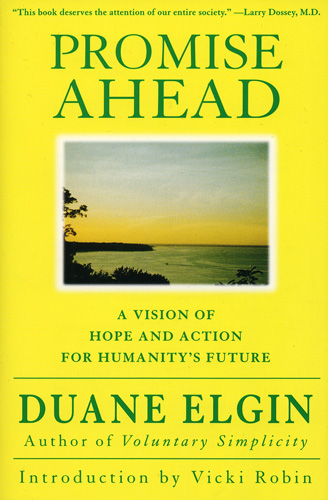
-
Duane Elgin wrote a new post, Awakening Earth: Exploring the Evolution of Human Culture and Consciousness 11 years, 10 months ago
Just as there are relatively distinct stages that characterize the development of an individual from infancy to adulthood, so too are there discernible stages in the development of our species as we move toward a […]
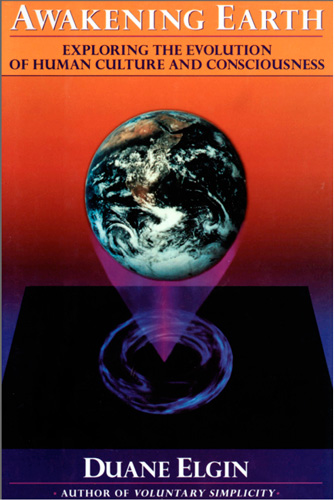
-
Duane Elgin wrote a new post, The Living Universe: Where Are We? Who Are We? Where Are We Going? 11 years, 10 months ago
Integrates deep insights from science and wisdom traditions to reveal the deeper unity shared by both and its meaning for humanity’s journey into the future.

-
Duane Elgin wrote a new post, The Living Universe — A video introduction to the book 11 years, 10 months ago
A short video (4+ minutes) that introduces the everyday nature and great importance of being awake to the aliveness of the universe.

-
Duane Elgin wrote a new post, Deep Big History: A Living Systems Paradigm 11 years, 10 months ago
The essay recognizes that all paradigms of reality are provisional and asks, “Although mainstream science views the cosmos as comprised of mostly dead matter and empty space, could the universe be regarded as a […]

-
Duane Elgin is now a Contributing Member 11 years, 10 months ago
-
Duane Elgin became a registered member 11 years, 10 months ago
-

welcome Duane….isn’t this a wonderful ‘place’? orla
-