

CMBR: The First Step in the Arc of Consciousness
Click for this Resource!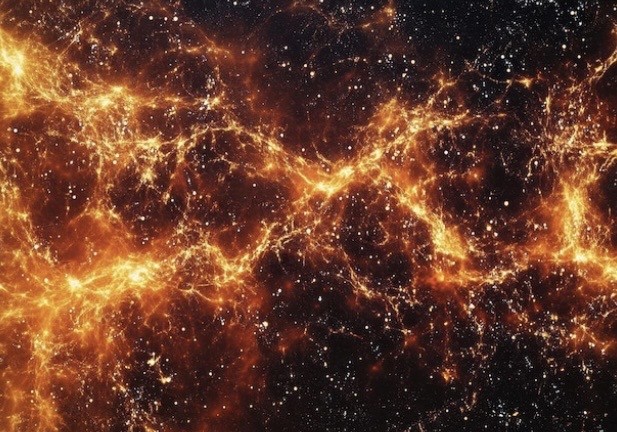
[pic is of Cosmic Microwave Background Radiation]
Why CMBR matters to the new Universe Story
CMBR is the baby picture of the universe — NASA quote, author unknown
Cosmic Microwave Background Radiation (CMBR) becomes more than the universe’s earliest visible relic; it becomes the primordial gesture of the very movement Teilhard and Thomas Berry devoted their lives to describing. The CMBR is the first moment the cosmos reveals itself as ordered, informational, and capable of interiority — the foundational conditions for everything that will later emerge as life, mind, symbol, and ultimately a universal synthesis model that encompasses them all. CMBR is the universe’s first act of coherence, the initial differentiation that makes all later complexity possible, and the earliest sign that evolution is not drifting but is purposive, goal-directed, and rising.
In this fully integrated model, the ancient field of light is the alpha-ground of the same developmental arc that bends toward Omega: a universe that begins by imprinting structure into light eventually becomes a universe capable of reflecting upon that structure from within. In relgious and spiritual traditions worldwide, the word used for this ultimate ecosystem of light in which all things consist and hold together in positive relationship is God. Throughout his writing, the author refers to this universal generative energy and information field as the God-of-the-Whole.
Light is not only the substance of all material form, but it also carries energy and information at all scales, acting as an incredibly fast, universe-wide messenger. By oscillating as electromagnetic waves or moving as particles (photons), light carries everything from the shape of a distant leaf to the digital data traversing global fiber-optic networks. Thus, the CMBR and Omega are not endpoints of different stories, but the opening and closing movements of a single cosmic symphony — one in which humanity’s emerging interiority is the latest expression of a trajectory that began with the first light, the common spirit-science element and nexus that unites the Big Bang (science), ancient scrolls (religion), and perennial wisdom tradition accounts of creation, harmonizing inner and outer worlds.
At the deepest levels everything originates and is nourished by the same source in light, the universal constant, substance, root, and pulsating heart of all science and religion. The word universe means “a reality turning around on one thing.” In seamless unity with the spiral motif, and consonant with the relativity theory of Einstein and modern physics, the author’s research points to light as the one thing in which all things consist and cohere.
Why Consciousness is Central to Cosmogenic Evolution and the New Universe Story
It is now understood that the new sciences and traditional religions both describe the same source of wisdom and love. This calls for a new level of thinking to make the leap across the abyss to create a better world and New Story. The old-world view locked us into a one-dimensional “only physical matter is real” reality of fixed and solid objects — a machine-like universe separated into parts, chronological time, linear step-by-step logic, and fixed conclusions based in existing circumstances. With advances in science and cosmology, it has become clear that the assumptions of a materialist worldview are either wrong or incomplete, in need of contemporary updates.
We are now in a time of evolution unlike any we have ever witnessed or known, when what must evolve now is more deeply interior than ever, human consciousness itself. Doing so requires the ability to distinguish between knowledge and wisdom, respecting that the latter is a more evolved way of knowing than the former by an order of magnitude, and learning how and where to find and embrace it. Wisdom centers lie deeper, in the heart of things. Head centers are in the intellect, and its vast storehouses of knowledge and information. Knowing (wisdom) is not the same as knowledge (information). Developing the former and allowing it to centrally inform the latter as tributary to it involves a major paradigm shift in human priorities and consciousness.
The quantum sciences and wisdom and religious traditions both point to the fields of energy and information that surround us, and are within us and all sentient life. These overlapping generative energy and information fields call for expanding the bandwidth of knowledge to balance out the rational-empirical way of knowing, welcoming the noetic (trans-rational and intuitive) dimensions in order to embrace inclusive, full-access knowing. Derived from the Greek, noeisis (inner wisdom) describes a direct, immediate, ineffable understanding that goes beyond the rational, discursive intellect, often including insights from meditation and profound transformative experiences.
Panspychism: Consciousness is fundamental, all things derive and emerge from it
The idea that consciousness is fundamental — meaning that it is a core building block of reality, like space and time, rather than a mere byproduct of the brain — is a prominent metaphysical (meta-religious) stance, often known as panpsychism, is championed by a diverse group of physicists, philosophers, physicists, and cognitive scientists. Notable advocates include: David Chalmers, Donald Hoffman, Philip Goff, Annaka Harris, and Bernardo Kastrup.
In keeping with the author’s spiral dynamics and taxonomy model in Homo spiralis, detailed in a recent DTN blog series, Kastrup posits that the universe is essentially a single, all-encompassing consciousness, and that individual minds are localized “whirlpools” of energy exchanging information within this greater mental field.
The concept of panpsychism has deep roots, with pioneers like psychologist-philosopher William James, and Max Planck (Nobel Prize winning physicist) suggesting that physical matter is derived from consciousness.
Pierre Teilhard de Chardin believed explcitly in panspychism in the sense that he viewed the universe as possessing both a “within” (psychic interior dimension) and a “without” (purely physical aspect). He argued that matter and spirit are two sides of the same coin, and that the physical evolution of the cosmos (cosmogenesis) is driven by the convergence, complexifying, and awakening of this inherent consciousness in the interior of the human being, psychospiritually.
Thomas Berry was deeply influenced by Teilhard, but avoided strict academic (and theological) labels like “panpsychic,” but his core cosmological vision strongly resonates with it. He famously asserted that the universe is not a collection of objects to be used (materialism), but a “communion of subjects” in relationship and community (living union). He argued that that all living beings and natural phenomena, from rivers and mountains to animals, possess inherent interiority, value, and subjectivity, all of which are core panpsychic concepts.
The sciences that support this worldview are based on post-materialist theories of consciousness as fundamental in the creation of the universe that from the Big Bang event continue to inform and maintain continuous creation. Many of the proponents of post-materialism have a background in quantum physics, perennial wisdom traditions, Eastern philosophy or spirituality, mysticism, or like the author have had incorporated their own inner knowing into their evidence-based rational analyses. Scientists with this experience are advanced in their own personal evolution, able to wisely discern that the universe is a spiritual enterprise — alive, intimate, compassionate, purposive, and wise. Such wisdom and knowlege does not develop in persons overnight, but by study, personal integration, and practicing the spiritual disciplines over time.
The age of nations and disconnected disciplines have passed for those who have attained unitive (liminal) consciousness. Unitive consciousness equips persons to not only know (intellect) but see and experience this union firsthand, or are striving to maximize or master a conscious breakthrough experience of same. The word liminal comes from the Latin, limen, meaning “threshold.” There is a tension between what only appear as two separate worlds — the unseen, non-material, non-dual world of consciousness, and the material, physical, dualistic world in which we live and work. The in-between stratum or liminal space is occupied by our liminal selves, groups, and teams when in their transcendent moments of integrated awareness.
Liminal (spiritualized) consciousness connects disparate-appearing parts, and inclines awareness to see and experiene their interbeing nature, and think in wholes. Being in the liminal space of full-access knowing will evolve our species by creating greater wholes, networks, and alliances that can transcend our cultural, political, and national differences, and make the world a better place. In this liminal space between “two worlds,” we can work together with the positive values of empathy, compassion, respect, and peace without habitually defaulting to competitive, racist, sexist, classist, siloed, or binary-based interactions.
There is only one, fully integrated world, visible to those who have attained liminal consciousness, or are striving to attain, maintain or improve upon same. Those who have experienced moments of liminal awareness have discovered that transcending differences is better than debate, compromise, retreating into corners, or agreeing to disagree.
Consciousness as Universal Container, the hallmark future evolutionary leaders
By definition, consciousness (light or Spirit) is fundamental to all created things as their Source or origin. As such it is both transcendent and immanent, that in which all things consist and cohere, the reconciler of all apparent contraries, paradoxes, and differences. It’s that state of wholeness and interconnectivity that exists before the mind divides them. Hence, pure consciousness, the awareness that one is aware, is the Universal Container for all things. It is everywhere, in the world but not of it, found both outside and inside the dimensions of height, width, depth, and of space-time itself. Studies of near-death experiences (NDE’s) and reincarnation memories have shown than consciousness survives death. Hence, consciousness must be a state of awareness that inhabits yet transcends the body and space-time, phenomena traditionally known as spirit or soul.
Along with institutional forms of religion, the contributions of the materialist, technological, social and behavioral sciences have been ineffective in integrating science, religion, and the variety of other siloed disciplines in bringing the world closer together. It is the author’s view that individuals, groups, and organizations of all kinds must first transcend group-think boundaries to overcome discursive thought patterns, separation consciousness, and faulty mortal beliefs about the God-of-the-Whole via accessing liminal consciousness, if they are to be viable and effective in carrying out their purpose or mission.
Fueled by technology that is now accelerated exponentially by AI, these evolutionary ideas point to a world that is increasingly moving into a spiritual age, rapidly evolving from mental (binary) and mechanical (materialist) states of siloed awareness toward liminal (spiritualized) states of consciousness. The state of liminal consciousness, being integral by nature, join inner and outer worlds by a common, irreducible element that exists in overlapping cosmic energy and information fields. In the past, this universal Cloud of Unknowing has been known by many names — among them Spirit, God, light, I AM-ness, and consciousness.
The author identifies the energy, architecture, and dynamisms of that common universal element in Part 8 of his recent blog series on Christogenesis, and here points to CMBR (light energy) as THE universe’s primary residual clue and thread leading to same in the heart of matter. Outlined below, this generative energy field complexifies and interiorizes in humans over deep time toward the evolution of spiritualized consciousness in Omega, eventually manifesting as realized light beings and light workers in the Ecozoic Age.
Teilhard made reference to the “stuff of the universe’ as a single energetic reality with an inner and outer face. Doing so he constantly referenes light in his writing, symbolically not physically, and refers to spiritual energy as a real force in the universe, not a metaphor, knowing that future science will discover its physical basis. His scientific-vocabulary remains pre-quantum-biology and pre-information theory, and therefore the physics of his time could only measure the “without,” not the “within” of things. This is the conceptual space where modern bio-photonics, coherence, and field-based models now operate, explained in Part 8 of the author’s recent series on the scientific evidence for same. That evidence supports Teilhard’s vision that Spirit and matter share a single energetic substate, and that consciousness (panspcychism) is a cardinal dimension of the cosmos, not an epiphenomenon.
Review: The Homo spiralis model provides what Teilhard lacked:
~ a mechanism (coherence, bio-photonic emission, field integration)
~ a taxonomy (stages of interiority and energetic organization)
~ a codex (spiral geometry, thresholds, archetypal integration)
~ a dual-aspect substrate (light/energy as both physical and interior)
Teilhard saw the need for such a framework but could not supply it, which effectively answers the question he left open and that every synthesis model must ultimately answer:
What is the substrate that unifies spirit and matter?
CMBR: the universe’s first gesture toward Omega, It’s first light and last horizon
Long before life stirred, long before the Earth cooled, long before stars ignited their first fusion fires, the universe released a breath of light that would never be repeated. It was not a blaze or a burst, but a settling, the moment when the early cosmos exhaled its first coherent whisper.
The Big Breath
“Breath” and the notion of breathing creation into existence is an apt description, both literal and metaphoric. Classical theology speaks of creation being “God breathed.” “The Big Breath” is used by some, particularly in spiritual, philosophical, or alternative cosmological contexts to describe the birth of the universe, often as an alternative to the purely explosive imagery of the Big Bang. While the Big Bang is the standard scientific model for the expansion of the universe, the term “Big Breath” offers a more organic, less “violent” interpretation of the initial rapid expansion.
Of particular interest, the words spiral and spiration are related to inter-being phenomena connecting the celestial and terrestrial, the “above and beneath” worlds, the radial and tangential energy continuum of vibrating light flow. In theology spiration is defined as the “action of breathing, a creative or life-giving function of the God-of-the-Whole.” Part of its definition means a “spiral formation” and “the relation subsisting by virtue of this procession.” Thus, divinity breathes or spirates life into creation via countless infinitesimal ellipses and spirals from its Zero-point spiracle (vortex), a breathing forth of the individual I AM from the breath of the I AM WHO AM Creator.
Spiration in all its forms — inspiration, respiration, inhalation, exhalation are the evidence that a new life has begun. New birth is confirmed with a cry, the sound of air moving across vocal cords. Just so, as embodied existence began when the universe was born, it has begun for all of us. In grammatical terms, the breath of life, the cosmic animating spirit is neither a noun or a verb, but a preposition. Pre-positioned throughout the universe at all scales, this animating energy moves over, under, around, and through the systems of material bodies swaddling and permeating them all.
Lungs, larynx, and lips give us the power to speak, to cry, to sing, to name, to praise, to pray, The mighty and creative rush of that Spirit (light/breath) blows also across windpipes, forming words, language, and speech, enabling us to utter a comforting or prophetic word, tell our stories, and make sense of our relationships.
Why the name Homo spiralis?
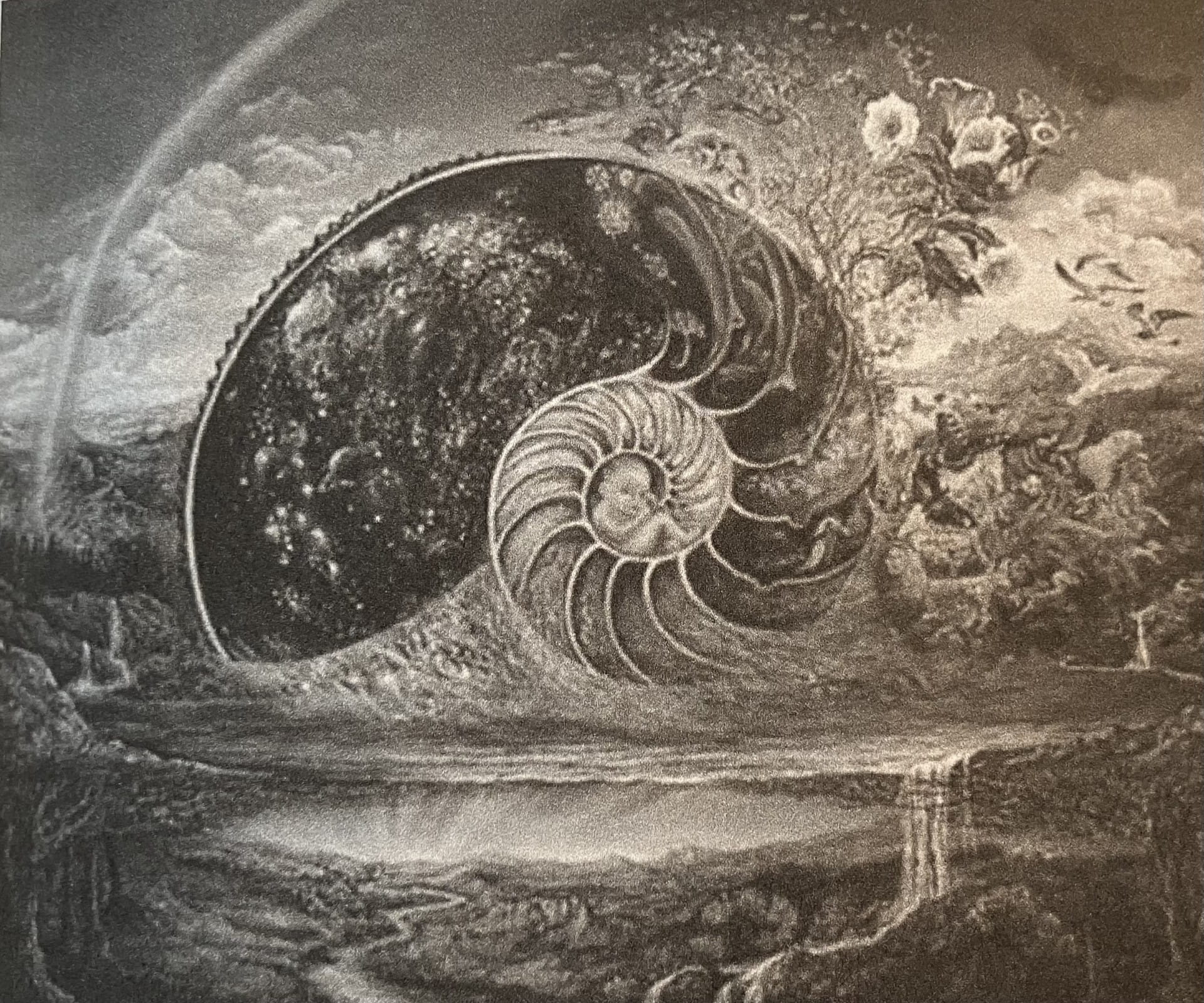
The author’s use of the taxonomy term Homo spiralis in naming his synthesis model stems primarily from this notion of light or “breath” (spiration) as Source, and secondarily because this fluid energy field creates the geometric architecture (spiraling forms) that are the signature icon of the universe at all scales. Both images capture the ideas expressed throughout his synthesis writing.
This liminal inter-being state of light (Spirit, breath, or consciousness) precedes and transcends the material (geological) and biological forms of existence, including the mental and moral sense of personal identity and all doing, causing things to evolve from the inside out in the heart of matter. Known in classical theology as hypostatic union, its radial (timeless) energy transforms to tangential (temporal) energy (quantum to classical physics) that sparks between the visible and invisible world, and between the material body and its hidden human spirit-soul (psyche). It also sparks between the two hemispheres of the brain, best expressed in the reconciled tension of apparent contraries in the psycho-spiritual integration of the human person. In physics, this union is known as entanglement, where each created thing is connected to every other thing in the universe via these relational fields, innermost and outermost.
The well-spring of the soul’s existence, this inalienable spark of divine light/love hidden in the depth of things, is the sames energy that created the Big Bang, only in scaled down form. Melting itself into creation, divinity enjoys itself there as one admiring itself (and other created forms) in a mirror. In the same enjoyment in which Consciousness (Spirit) enjoys itself, it enjoys all things.
This breath or whisper is what we now call the Cosmic Microwave Background Radiation (CMBR), the light of the world that complexifies, converges, and interiorizes in persons over a lifetime, and in the human species over deep time. The CMBR is otherwise defined as the relic radiation, “afterglow,” or fossil radiation of the Big Bang, representing the first light released around 300,000 years after the universe began, filling all space as a nearly uniform glow (see pic above). In a temporal sense, it is sometimes described as a “shell” or sphere of photons, looking back in time to the moment of emission. As there are some who look at the expanse of universe itself as a macrocosmic brain, that shell or sphere would be its radiant aura or halo.
CMBR is the oldest light we can see, but more importantly, it is the first moment the universe became readable. Before this the cosmos was opaque, a seething plasma where photons could not travel freely. But when the universe cooled enough for matter to take form, light was released into openness to work its magic and do a multitude of creative things.
Though still rendered as untenable by the empirical sciences, the relationship between light energy and its manifestations in personal development, evolution, consciousness, and spiritual awakening, transformation, and transfiguration, is not to be overlooked or underestimated.
Teilhard, Berry, and the Homo spiralis framework harmonize
Teilhard would have recognized this moment instantly. Not so much as physics, but as direction. For him, evolution was never a random drift, but a rising curve — matter complexifying, interiority deepening, and consciousness awakening, explainable via the physics that would come after his time. The CMBR is the first visible trace of that rising curve fueled by that unknown (quantum) physics that Teilhard called radial energy. It is the earliest sign that the universe is not chaos but ordered becoming.
Berry would have said the same in his own language: that the CMBR is the first expression of the universe’s three great principles — differentiation, interiority, and communion.
~ the tiny temperature variations are differentiation, the universe’s first gesture toward uniqueness.
~ the encoded structure is interiority, the cosmos holding information within itself.
~ the field permeating all space is communion, the relational fabric binding everything together.
In this sense the CMBR is not merely ancient light. It is the first page of the universe’s autobiography (an auto-cosmology written in living, “breathing” spirals). And it is the first step in the long arc that leads to the Homo spiralis taxonomy and codex.
For the Homo spiralis model is not a biological speculation or a deep dive in quantum physics, it’s a continuation of the universe story, the next turn in the same developmental movement that began with that first coherent field of light. The CMBR is the alpha of that movement, and Omega is its horizon. CMBR is the universe’s first act of self-disclosure. Omega is its fulfillment.
Between them stretches the entire evolutionary arc:
~ starting from a generative energy field —> to form —> to life —> to mind —> to symbol —> to reflective interiority —> to the integrative consciousness of Homo spiralis —> and finally toward Omega, the point of convergence where the interiority becomes fully awake to itself.
The CMBR is the first moment the universe becomes capable of producing beings who can ask the question of meaning. Omega is the moment when meaning becomes fully conscious of its cosmic origin. And Homo spiralis is the stage of evolution (noosphere) capable of perceiving the deep continuity between them, standing at the threshold where the universe begins to know itself through us.
Beginning and end, alpha and omega, first and last are NOT opposites
In this way, the first light and the last horizon are not opposites. They are the bookends of the same story, its alpha and omega. What begins as uncreated light (radial energy) transforms to created light in space-time (tangential energy) and returns to origins as transfigured light (Omega) in the Pleroma. Just like in baseball, where the runner begins his journey on a circuitous path between four memes (bases), milestnes pointing to his return. If successful, the journeyman-base runner arrives where he began, safe at “home,” but from a different direction (angle) altogether. Hopefully, none-the-less for wear despite contrary resistances (opponents) bent on ending or impeding his path along the way.
The Birth of Structure, (how a primordial pattern became the architecture of complexity)
From the faint imprints in the CMBR, the universe began shaping itself into form by expanding outward from its tiny center. Gravity amplified tiny fluctuations into the first stars, galaxies, and cosmic webs, the scaffolding for all future complexity.
Teilhard would see this as the universe’s first great consolidation, matter gathering into higher orders of organization. Berry would recognize the deepening of communion: stars and galaxies forming not as isolated objects but as relational communities.
In the Homo spiralis model, this era marks the transition from energy field to form, the universe establishing stable architectures, structures capable of holding memory, pattern, and potential. Without this long epoch of structure-building, the later emergence of life and mind would be impossible.
The Long Patience of Matter (chemical deepening and the preparation for life)
As stars lived and died, they seeded the cosmos with heavier elements — carbon, oxygen, nitrogen, iron — the essential ingredients for life. Planetary systems formed around second-generation stars, creating environments where chemistry could linger long enough to become biology.
Teilhard would call this the slow ascent of complexity; Berry would see it as the universe’s deepening interiority, matter learning to hold more intricate forms of order. In the Homo spiralis segment of cosmogenic evolution, this is pre-biological interiorization of the cosmos: matter becoming capable of self-organization, metabolism, and eventually consciousness. The universe was not rushing, it was preparing the conditions for the next great leap.
Life as the universe’s first interior (biology, the awakening of self-organizing complexity)
Life marks the moment when the universe begins to fold inward — when matter becomes capable of maintaining itself, sensing its environment, and preserving information across generations. Teilhard saw biological life as the first true expression of interiority, the point where evolution becomes unmistakably directional. Berry viewed life as the flowering of the universe’s communion, the “urge to merge” (Swimme), each organism participating in a larger ecological whole. In the Homo spiralis model, biological life is the first interior field, the first system capable of integrating information, responding to novelty, and evolving toward greater coherence. With life, the universe begins to awaken from within.
Mind as the universe turning inward; neural complexity, and rise of symbolic awareness
With the emergence of nervous systems, and eventually brains, the universe gained the ability to reflect, imagine, remember, and anticipate. Teilhard saw mind as the intensification of interiority, the deepening of the noosphere. Berry saw it as the universe becoming conscious of its own story. In the Homo spiralis model, mind is the second interior field, capable of symbolic thought, narrative, and meaning making. This is the stage where evolution shifts from genetic to cultural time, and where the universe begins to articulate itself through language, art, and shared understanding. Mind is the bridge between biology and the reflective interiority that will culminate in ever higher levels of cognition and unitive (spiritualized) consciousness in the Homo spiralis arc of cosmic evolution.
Homo spiralis, and the deepening of interiority (human consciousness as the integtrative stage of the cosmic arc)
The Homo spiralis evolutionary path is the back-stretch heading for “home” and the cosmogenic finish line. It represents the stage where consciousness becomes integrative, capable of holding complexity, ambiguity, and unity simultaneously. It is not a new species but a new mode of interiority: reflective, relational, field-aware. Teilhard anticipated this as the rise of the noosphere; Berry saw it as the moment when humans assume their role as conscious participants in the universe’s unfolding. In the Homo spiralis model, this stage is the third interior field, where symbolic mind becomes capable of self-transcendence, coherence, and alignment with the deep evolutionary trajectory that began with the first light.
Omega: the horizon of convergence (the fulfillment of the universe’s long ascent)
Omega is not an endpoint but a horizon, the culmination of the universe’s movement toward unity-in-complexity via a spiritual awakening and spiritual consciousness that sees and thinks in wholes. Teilhard described it as the final convergence of interiority, the point where consciousness becomes fully coherent, unitive, and relational. Berry saw it as the Ecozoic horizon, where humanity lives in mutually enhancing relationship with the Earth and cosmos. In the Homo spiralis portion of the arc, Omega is the fourth interior field, the integrative culmination of the entire cosmic arc: a generative light field whose trajectory evolves to —> form (matter) —> life —> mind (nous) —> reflective interiority —> convergence.
The Arc of Consciousness summarized
Convergence occurs at that moment in personal and/or global evolution when transformed light energy (science), or the God-of-the Whole (referred to obliquely as “the universe”) is fully aware of its own becoming, essence, and identity in a cosmic energy and information field of light. This energy first appeared as plasma following the Big Bang/Breath event. The plasma cooled to form the material world, leaving its energy embedded in the heart of matter. Earth’s indigenous peoples referred to this invisible light in nature as Spirit, which in the modern era became measurable in the universe’s Big Bang afterglow (aura) as the CMBR. As that generative light energy and information field further transformed and interiorized over deep time, it evolved into consciousness itself. Later, it awakened and transformed into its highest frequency, becoming spiritualized human consciousness in its trajectory toward Omega.
This is how the first light became the last horizon, how Alpha became Omega, and how radial energy (light) transformed to tangential energy (matter) that became structured in the universe’s spiraling geometric architecture (geosphere). Next, it complexified into four interior fields starting with the beginning of life, biology, and with it Homo spiralis, the first interior field, the first system capable of integrating information, responding to novelty, and evolving toward greater coherence.
From there this cosmic energy continued to evolve, complexify, deepen, and interiorize into other fields, centrating via chemical deepening, primitive brain structures, and neurology before manifesting as mind, or the second interior field of Homo spiralis evolution: symbolic, narrative, and meaning making. This is the stage where evolution shifts from genetic to cultural time, and where the universe begins to articulate itself through language, art, and shared understanding.
This was followed by the stage where consciousness becomes integrative, the third interior field, capable of holding complexity, ambiguity, and unity simultaneously. Not a new species, but a new mode of interiority: reflective, relational, field-aware. Teilhard anticipated this as the rise of the noosphere; Berry saw it as humanity assuming its role as conscious participant in the universe’s unfolding, before converging into spiritualized (liminal) consciousness, the fourth interior field, and the fulfillment of light’s long ascent toward its transfiguration in Omega.
Closing reflection: a universe becoming conscious of its story
Standing back from the sweep of cosmic history, what becomes clear is that the universe has never been static. Rather, it has been becoming from the beginning, rising from field to form, from form to life, from life to mind, and now from mind toward a new mode of reflective interiority. The faint patterns of CMBR were not the end of something but the beginning of a trajectory that continues through us. Teilhard saw this as the deepening of interiority; Berry saw it as the unfolding of a communion of subjects; the Homo spiralis recognizes it as the universe learning to integrate itself from within; and where the God-of-the-Whole recognizes itself spreading across the span of eons as light appearing in a variety of forms and images at all scales.
We are participants and observers in that movement at the same time — participant observers, active witnesses of same. The same coherence that shaped the first stars now shapes our capacity for meaning. The same interiority that stirred in the first living cells now stirs our ethical and symbolic lives. The same arc that began with the first light bends toward Omega, a horizon where consciousness becomes more unified, relational, and aware of its cosmic origins in a common universal element that science calls light, and global religions refer to as God.
To recognize this is not to inflate the human role but to understand it. We are the universe (God-of-the-Whole) in its reflective phase, the place where the long ascent of interiority becomes capable of seeing itself as part of a story that began billions of years before we arrived. The cosmology is not background; it is the ground of our being, where the seer and the seen, subject and object, observer and participant, spirit and soul are one and the same entity in cosmic union and communion, mutually gazing at each other within, between, and among themselves in the same unifying field as all created things. And the future of that story depends on whether we learn to live in alignment with the deep coherence that has been guiding ourselves toward seeing that in unitive consciousness from the very beginning.
The first light still speaks. The question now is whether, as a collective, we are willing to listen and speak to others about what we hear that they may ponder and experience same. However, this groundbreaking narrative challenges the belief systems of many. There are those who believe that the acceptance of a new scientific and religious truth is dependent on a whole new generation open to learning new things. Some studies suggest that for an entire community or world to embrace a new paradigm, only 10% of a population needs to become convinced. Having reached that tipping-point a paradigm can spread through social networks and alter behaviors on a large scale. Either way, only a remnant (minority) at a given time will be receptive to change, whether that ever reaches critical mass soon enough to turn the entropic tide of humanity on a global scale remains to be seen.
At the last, at the individual level our “New” Universe Story ends where all stories end. The beginning is in the end, and the end is in the beginning, first and last, Alpha and Omega, symbolized by the ancient image of the Ouroboros, the snake with its tail in its mouth.
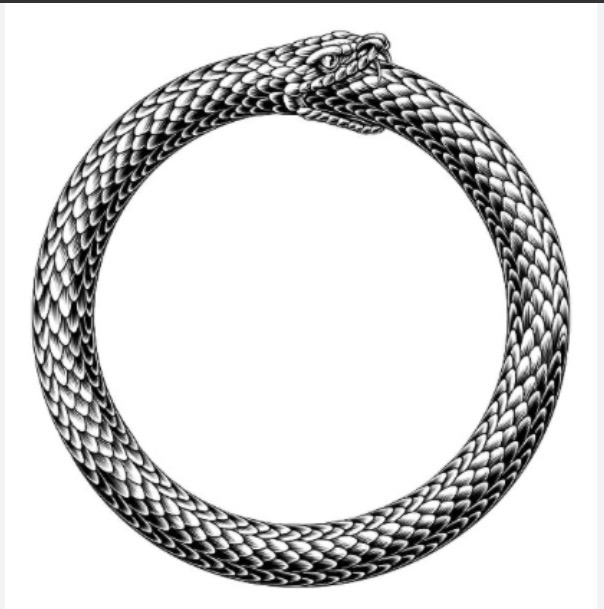
Poets always seem to put the best words in the best order. Said Coleridge, “The common end of all narrative, nay of all poems, is to convert a series into a whole; to make those events, which in real or imagined history move in a straight line, assume to our understanding a circular motion — the snake with its tail in its mouth” (Samuel Taylor Coleridge, Collected Letters 4:545).
Being circular, the soul’s journey is from descending (cascading) levels of self-consciousness into matter to the ascent back to Spirit (God-consciousness), from the One back to the One again via the many. This theme is not new, it has been present in traditional religions, perennial wisdom traditions, and classic literature, perhaps best illustrated in Coleridge’s The Rime of the Ancient Mariner, Homer’s two-fold epic of “departure and return” in the Iliad and the Odyssey, and Joseph Campbell’s The Hero’s Journey, describing the three-part transformational path of departure, initiation, and return, cardinal aspects of the hero’s journey from timeless radial energy to temporal tangential energy and back, as in a circuit. The only thing new in the world is the history, science, art, literature, and perennial wisdom traditions that we don’t know, and haven’t yet put in synthesis form
Without the ascending steps on the homeward path, there is no return for the otherwise lost and wandering soul, which must follow the spiral pattern (labyrinth) all the way back to its origin or zero-point in the quantum field of Spirit. Spirit is the innermost dimension of the soul and body, its highest aspect and vibrational Source. Intended or unintended, souls seek the wellspring of their creation, as salmon seek the stream beds of their origin to spawn, create new life, and die, mimicking the cycles of nature, and the spirit-soul’s journey in space-time. The flowing out is a flowing back, a return, circling round the zero-point vortex (spiracle) like a swirling column of water circles down a drain. The exit is a return; the return an exit.
The universe is a spiraling spiritual enterprise, alive, intimate, compassionate, and wise.
Only in the Ground of Being, light (God-of-the-Whole) are the end and beginning identical.
For the whole of life and being of creatures is nothing but a crying and hurrying to be back again from whence they came out (Meister Eckhart).
Each journey begins at the zero-point vortex of a spiral that is connected to a series of ascending spirals where the end of one begins another. Each successive spiral (stage/meme) in personal development, and deep time history begins in a cocoon-like stage that feels dark, restrictive, and solitary, a “dark night of the soul” necessary for preparing persons and the species for another level of transformation to an unimaginable destination “over the rainbow, way up high” as the fabled song goes.
Alas, while ever renewing, the New Universe Story is an Old Story; an archetypal tale of opposites reconciling and circling round again with an intelligible evolutionary end, not once told, but retold, and told again. Like a classic movie worth seeing over and again for its universal auto-cosmogenic resonance. Hence, the first step in the arc of consciousness involves a forgetting (amnesia), as do the last steps in remembering, and awakening to who we are and from whence we came in order to make a better world, leaving a synthesis legacy for those who follow.
Scientific debate over aspects of an evolutionary point of view
There is and has been a substantial body of scientific evidence from multiple independent fields that support evolution, the notion that species diverge from common ancestors. The evidence does not show a cat turning into a dog or a monkey giving birth to a human. Rather, it indicates that species diverge from common ancestors over deep time. And in the authors view, from a common Source in light (overlapping generative energy and information fields).
The major scientifc debate today is generally not over whether evolution occurs. More often the questions concern:
~ the mechanisms driving evolutionary change
~ the relative importance of natural selection, genetic drift, developmental constraints, and other processes
~ the pace and patterns of evolutionary history
~ whether evolutionary theory fully explains the emergence of consciousness, morality, and human self-awarness
Theological objections to an evolutionary point of view
Many religous thinkers, including figures such as Teilhard and Thomas Berry, accepted the scientific evidence for biological evolution while disagreeing with purely materialistic interpretations of it. For them, the question was not whether evolution occurred, but whether evolution itself might be part of a deeper spiritual process.
The oppositon to Teilhard and evolutionary perspectives came from several directions, and not all critics objected for the same reasons. Many theologians feared that such models softened (altered) the biblical doctrine of the Fall that describes the origin of separation consciousness (sin) in need of redemption from a transcendent God. In classical Christianity, Christ comes primarily to save humanity from sin and reconcile humanity with God.
Some argued that the Cross became less central in his system than cosmic development and convergence. Others argued that Teilhard was optimistic about human progress wheras the ancient manuscripts are not, the latter arguing that as history progressed, many would fall away from godliness whereby Christ would come to Earth a second time, not to repair or reclaim a lost and fallen world, but to replace it with his kingdom on Earth. Advocates for same cite the words of Jesus to that effect recorded in the gospels, and in the epistles (letters) written by the Apostle Paul.
For example, influential Protestant theologian Karl Barth stressed humanity’s radical sinfulness (fallen nature) and God’s transcendence. Barth regarded attempts to identify God’s purposes with historical progress as dangerous. Critics pointed out that Teilhard used traditional religious terms in new ways, terms like Creation, Redemption, Resurrection, Kingdom of God, making traditionalists feel like they were reading a new theological system wearing traditional religious clothing. The concern was not necessarily that evolutionists like Teilhard and Berry rejected Christianity outright, but that they transformed it so extensively that it became something different, almost unrecognizable on core doctrines. Such are reasons why both Teilhard and Berry saw it necessary to transcend broaden the narrow scope of cosmology, making it more inclusive and consistent with scientific and evolutionary discoveries.
Critics raised questions:
~ is Omega the same as the biblial New Creation? Is it a spiritual reality or an evolutionary inevitability? Does human progress bring about the Kingdom, or does God bring it about through divine action? Or is it the latter working out its plan in history as it unfolds over deep time? Many believed Teilhard left these questions insufficiently answered.
~ And most importantly, is Christianity fundamentally the story of humanity’s fall and redemption, or is it the story of an unfinished creation evolving toward divine fulfillment? Teilhard leaned strongly toward the second formulation, while many theologians believed the first must remain primary. The latter cite Teilhard’s optimism in the absence of any substantive moral progress despite humanity’s many medical and technological advancements, evidenced by the proliferation of twentieth century wars (the bloodiest in history), genocide, nuclear proliferation, man’s fouling the planet past an irreversible tipping point in climate change, and the increase in the globe’s totalitarian regimes.
Many theologians felt that Teilhard’s confidence in evolutionary advancement was not only unsound theologically over against the ancient manuscripts and recorded words of Jesus, but underestimated the depth of human evil.
A biblical-spiritual reading of current events, therefore, has taken at least two forms:
- Apocalyptic — seeing present world events as signs of an approaching climax of judgment and divine intervention.
- Evolutionary — seeing present turmoil as the birth pains of a higher stage of human spiritual development still unfolding, continuing to work through its multiple convulsions and tribulations.
The author believes a third option is entirely possible, as the Earth may be on the brink of its Sixth Great Extinction event, humanity having to face and undergo significantly decimated populations due to nuclear holocausts, famines, and/or pestilences, leaving a remnant to rebuild on an agreed upon (and enforceable) foundation, one with a more sacred regard for the Earth, and all life systems built on higher moral ground.
All three approaches share a common conviction: history is not ultimately meaningless. Beneath the visible currents of economics, politics, and culture lies a deep story concerning the destiny of humanity and its relationship with the God-of-the-Whole that continues to unvold.
One could summarize the biblical perspective in a single sentence:
History is the visible unfolding of an invisible spiritual drama, and current events may be understood not merely as geo-political happenings but as manifestations of deeper movements in humanity’s relationship with itself via an awareness of its evolutionary purpose, the God-of-the-Whole converging within the human spirit-soul toward unitive consciousness.
About the Author
Joseph C. Masterleo, LCSW-DCSW, is a clinical social worker in private practice in Syracuse NY, and Rockledge FL. His half-century of service in the mental health care field includes faith-based counseling and psychotherapy, with an emphasis on psycho-spiritual integration. His subspecialty involves developing a novel paradigm for the synthesis of science, religion, and psychology, identifying the energy and geometric patterns that connect the quantum world with space-time, inner and outer worlds. His model explains how spirit and matter can co-exist as two facets of one reality in a unified field, dissolving the walls of partition between previously siloed disciplines. Inspired by the writings of Thomas Merton (ecumenism), Teilhard de Chardin (synthesis), Thomas Berry (ecotheology), Nikola Telsa (electromagnetism), Richard Rohr (Cosmic Christ), Ilia Delio (christogenesis) and others, his objective is to tell a new, future-looking story for the Ecozoic Age, one that forms a connecting bridge between the biblical story of creation, modern science, and ancient cosmologies. His columns on these and related subjects have appeared on websites such as The Center for Christogenesis, Progressive Christianity, and in newsprint via The Goodnews Paper, the Syracuse Post Standard, and the Syracuse Sports Magazine, where he comments on sports as reflecting the best and worst of American character and culture. Further information about Joe and his Spirit-Science model can be found in his book, The Ambient Christ, the Untold Story of God in Science, Scripture, and Spirituality, listed on Amazon Books, Barnes & Noble, and on his website www.joeknowsgod.com
- Used by people who call the work: Cosmic Evolution, Story of the Universe
- Applies a deep time evolutionary perspective to: Art, Biology and Earth Systems Science, Current Issues, Ecology/Sustainability, Education, Religion/Spirituality, Science
- Learning Stages: Adult Education, Higher Education, Lifelong
- Type: Article, Blog
- Keywords: noetic, consciousness studies, participant observer, unitive consciousness, Teilhard, liminal space, liminal self, liminal consciousness, consciousness as universal New Story Container, Cloud of Unknowing, codex, The Big Breath, The Big Bang, spiration, Homo spiralis, CMBR, interiorization, pre-biological interiorization, Ouroboros, Samuel Coleridge, Thomas B
- Why I love this Resource: it identifies the pathway of cosmogenic evolution in full, and its endpoint in unitive (lininal) consciousness
- Link to Resource: Click here
- Posted By: Joe Masterleo
- Date Added: May 31, 2026